Since my family and I are traveling, I don’t expect to post anything until Tuesday. Meanwhile, I’m flattered that this blog has been nominated for the Koufax Award in the “best expert blog” category. Voting hasn’t started yet, but please consider voting for me when the polls open. Some of the other nominees attract easily 100 times as much daily traffic as I do, so I’m going to be buried. But I’d love to get at least a few votes.
Author Archives: Peter Levine
Cheney and the press
Jay Rosen has the best commentary on how Dick Cheney has handled the press after the shooting accident. As a foil, Jay quotes former White House Press Secretary Marlin Fitzwater: “If [Cheney?s] press secretary had any sense about it at all, she would have gotten the story together and put it out. Calling AP, UPI, and all of the press services. That would have gotten the story out and it would have been the right thing to do, recognizing his responsibility to the people as a nationally elected official, to tell the country what happened.”
Jay replies: “But Cheney figures he told the country ‘what happened.’ What he did not do is tell the national press, which he does not trust to inform the country anyway. … He treated the shooting as a private matter between private persons on private land that should be disclosed at the property owner’s discretion to the townsfolk (who understand hunting accidents, and who know the Armstrongs) via their local newspaper, the Corpus Christi Caller-Times.”
Note the synecdoche in Fitzwater’s statement: API and UPI stand for the people and the country. Cheney doesn’t accept that, and neither do I–not in the age of blogs and other peer-to-peer media. A few national news organs do not have a right to be informed about anything in particular–especially since the news will get out anyway. However, Jay also argues that the old relationship between the national press corps and the White House served as a check on the latter, and that something must be able to challenge the presidency.
For my part, I have two incompatible reactions to this affair:
are sports good for democracy?
Joey Cheek (age 26), the winning speedskater, has decided to donate his whole Olympic prize to Right to Play, a nonprofit that serves poor kids in the developing world. He also took the opportunity to speak out on an issue. “In the Darfur region of Sudan, there have been tens of thousands of people killed,” Cheek said. “My government has labeled it a genocide. I will be donating it specifically to a program to help refugees in Chad, where there are over 60,000 children who have been displaced from their homes.”
This is just an anecdote about one American athlete who pays attention to social issues and takes action. His story helps to balance all the anecdotes about bad behavior by athletes. But what happens if we move from anecdotes to data? Today, CIRCLE releases two studies on the relationship between athletics and civic engagement. We find that sports participants are much more likely than other youth to volunteer, vote, and follow the news. That correlation does not prove that sports causes civic participation. However, the correlation remains after we control for all the other variables measured in the survey, including academic success and participation in other groups.
 This is suggestive evidence that sports makes people into more active citizens. That could be because athletics teaches discipline and teamwork, or because it exposes kids to others who are (somewhat) unlike themselves, or even because athletes sometimes talk about issues on their way to practice.
Today’s release is getting quite a bit of interest. I did interviews this morning for national CBS radio news and local drivetime radio in Washington (WTOP). Also, that’s my hand on the bottom of the basketball.
interracial tolerance among the young
My organization is cited in this story in USA Today: Sharon Jayson, “New generation doesn’t blink at interracial relationships”:
Ryan Knapick and Josh Baker have been best friends since fifth grade. Colette Gregory entered the picture in high school. She and Josh are dating now. Knapick is white, Gregory is black and Baker is half-Hispanic. To them, race doesn’t matter. …
He and his friends are among an estimated 46.3 million Americans ages 14 to 24 ? the older segment of the most diverse generation in American society. (Most demographers say this “Millennial” generation began in the early 1980s, after Generation X.) These young people have friends of different races and also may date someone of another race.
This age group is more tolerant and open-minded than previous generations, according to an analysis of studies released last year by the Center for Information and Research on Civic Learning and Engagement, part of the University of Maryland’s School of Public Policy. The center focuses on ages 15 to 25.
While the youngest generation is the most tolerant on record–and that’s a fact worth celebrating–our research showed a gap between attitudes and behaviors. For example, only 4% of young Americans (age 18-25) say that they favor segregated neighborhoods. That’s down from about 25% in the 1970s and it’s lower than the rate among people over age 25. This change is almost entirely attributable to the arrival of new generations: individuals do not seem to change much over their lifetimes. (Source: General Social Survey.)
Nevertheless, more than half of young churchgoers say that their congregations have members of only one race–the same rate as among older people, and not much different since 1975 (GSS). In the Social Capital Benchmark Survey (2002), 66% of young White people who belonged to participatory groups said that all the other members were also White. This rate was not much different for older Whites. In the same survey, just 20% of young people claimed that they had invited a friend of another race to their house–better than the 6% rate among adults over age 56, but still not so common.
Will tolerant answers to survey questions translate into real social change if people remain quite segregated in their daily lives?
religion and politics in the Muslim world and the USA
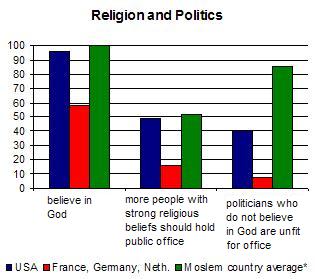
A colleague returned several months ago from a distinguished meeting of intellectuals from Europe, America, and the Middle East. He reported that the Islamic participants had confused us with France. That is, they thought that the United States was a highly secular, formerly Christian country with low tolerance for faith. Presumably, they drew generalizations about the “West” on the basis of what they know about the European countries that had once colonized them and that now absorb many of their emigrants.
In reality, Americans’ opinions about religion and politics sometimes lie closer to those in the Islamic world than to those of Western Europeans. Above, I show data from the World Values Survey (1999-2003). The “Moslem country average” is an unweighted mean of Algeria, Egypt, Jordan, Morocco, Pakistan, and (for the belief in God question only) Saudi Arabia. I show an average of France, Germany, and the Netherlands as representative of Western Europe.
Since Denmark is in the news, I’ll mention these results: 68.9% of Danes believe in God (compare 100% in Pakistan and Egypt, and 96% in the US), 3.7% of Danes think that a politician who doesn’t believe in God is unfit for office (compare 94.9% in Pakistan); and 5.6% of Danes think that it would be good for more religious people to hold public office (compare 91.2% of Egyptians).