Author Archives: Peter Levine

bridging the gap between what universities can offer and what students can do

At its best, a college education offers students–regardless of their career plans–opportunities to participate as apprentices in real research that addresses unanswered and pressing questions. That experience is good for the mind and the character. I think people understand the value of such work in a scientific context; they realize that they (or their children) would benefit from a summer’s work in a biology lab. The humanities, the arts, and the social sciences offer comparable benefits.

It is largely in order to create such opportunities that we train college teachers in PhD programs that emphasize research; that we grant them tenure in return for a record of active scholarship; and that we expect them to publish in peer-reviewed journals.

But the fact is that most students never experience actual research. Most do not come to college with the skills and knowledge necessary to take advantage of such opportunities. Many would not willingly choose to participate in research. A majority of American professors are not actually and currently involved in scholarship. And some of the most prolific and talented scientists and scholars are uninterested in teaching of any kind. The combination of those factors reduces the set of students and faculty who work together on real research problems to a very small number.

I’d resist any reforms that would reduce the size of that set or that would limit such experiences to elite institutions. Thus I’d resist efforts to move professors away from scholarship. But I also reject the status quo. We can’t be satisfied if most students miss the intended benefits of higher education–benefits that are supposed to derive from tenure, peer-review, and graduate education. Nor can we simply wring our hands in despair or blame other institutions, such as high schools, if there is a gap between students’ backgrounds and the best opportunities we offer at our institutions. We have to take responsibility for the gap.

Some of the most promising answers, such as the Gemstone Program at my university, pull together teams of students to conduct ambitious collaborative projects over more than one semester. This is a different model from the individual student in the lab or seminar room. The research is student-led, hence not really at the frontier of an academic discipline. In some cases, students pursue questions that have already been answered; they reinvent the wheel. But their projects are challenging, and the professors who coach them can draw on their expertise.
Murtha is completely unacceptable

Here is the full FBI surveillance tape from the Abscam investigation, dated January 7, 1980. That’s Representative Murtha on the couch. Scroll forward to about 12:00 on the tape and listen until about 18:35. (The most dramatic part is toward the end of that segment.)

The question is not whether the Congressman committed a felony; there’s some doubt about that. The questions are: What is Mr. Murtha doing in that townhouse? What’s his view of his job? What does he consider an appropriate “deal”? How does he comport himself as a Member of the United States Congress and a representative from Pennsylvania?

Continue reading

politics as a spectator sport

In the Baltimore Sun on Nov. 5, Michael Hill wrote a piece entitled “Insiders’ game: More and more, governing has become a process that leaves ordinary Americans watching from the sidelines.” He began:

This time of the year, there is a seamless flow on television as Sunday morning turns to afternoon, from the political talk shows to the NFL pre-game programs.

Both feature pontificating pundits chosen as much for their personalities as their insight. Style is at least as important as substance.

Most significantly, both are spectator sports. Professional football was designed as that. American politics was not.

Even on the verge of an election that has energized the electorate more than most mid-term votes, it still seems that the citizens are on the sidelines of a game that was once famously said to be “of the people, by the people and for the people.”

Hill then quoted Benjamin Ginsburg and Matthew Crenson, co-authors of Downsizing Democracy : How America Sidelined its Citizens and Privatized its Public; Harry Boyte from the University of Minnesota; and me.

I’m as satisfied as the next blogger about last week’s good thumpin’, which was richly deserved. Further, I don’t blame the Democratic Party for the way they played the game. Under the circumstances (one-party rule in disastrous times), the election was inevitably a referendum on the incumbents’ performance. To have injected other themes might only have created ambiguity.

Nevertheless, we can pause and lament with Hill the reduced role that citizens now play in politics.

First, it’s striking that turnout in such a high-stakes election was so poor. Only 40 percent of the eligible electorate voted, according to Curtis Gans. There were big increases in turnout in some states, but they were undermined by decreases in other places. For most citizens, a Congressional race is largely meaningless because the outcome is foreordained by the way districts are drawn.

Second, although I am closely attentive to national news, I heard little or no talk about critical issues such as the federal deficit, poverty, global warming, high school dropouts, or crime and its consequences. I suppose the minimum wage debate represents a proxy for poverty issues, but it is very far from adequate as a policy lever. One of the best arguments for national elections is that they provide an opportunity for public discussion and learning. That opportunity was missed.

Third, there was no empowerment agenda–no talk of how citizens have become spectators but could be given new responsibilities for self-government. This is a deep problem exacerbated by the complexity of modern issues, the delegation of power to administrative agencies and courts, the weakness of grassroots groups, and the influence of specialists (lawyers, economists, professional educators).

Conservatives respond to public unease about spectator politics when they attack “activist judges” for “legislating from the bench”; but their critique is usually inconsistent and opportunistic. Some progressives may have seen voting as a sufficient form of empowerment in 2006–but it isn’t. We will need richer and more demanding forms of civic engagement if we are really going to grapple with our problems.

an analogy

The Sixties The 2000s
1960 election: Reflects unusually high degree of ideological consensus. The main issue is the personality of the incumbent VP versus "change." 2000 election: Reflects unusually high degree of ideological consensus. The main issue is the personality of the incumbent VP versus "change."
Series of national traumas: Assassinations of JFK, MLK, RFK, race riots, Kent State Series of national traumas: 9/11, anthrax, Katrina
Escalating war in Southeast Asia Escalating war in Southwest Asia
Left mounts strong challenge to the ideological status quo (with a basis in cultural/personal issues) Right mounts strong challenge to the ideological status quo (with a basis in cultural/personal issues)
Ideological backlash: Nixon elected Ideological backlash: Democrats take Congress
Residue: cultural change in a libertarian direction, lingering resentment on the right, generally more conservative economic policies Residue: ???

the long-term political trends

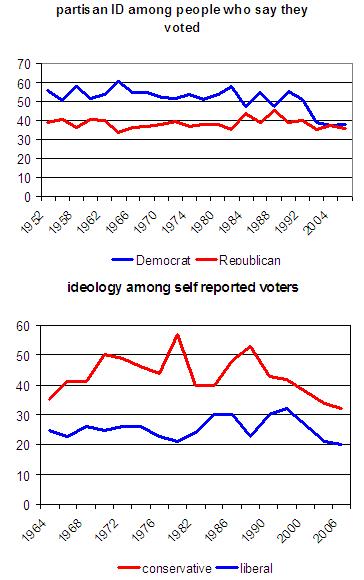
Here are trends for Democrats versus Republicans and liberals versus conservatives over several decades. The sources are National Election Studies for 1952-1992, and exit polls thereafter.

Democrats lost their advantage in registration during the 1990s, mainly because conservative Democrats quit. The party held a very slight (2-point) edge in 2006, but the score is basically tied. Independents have become much more numerous among actual voters than they were in earlier decades.

Self-described “conservatives” have substantially outnumbered self-described “liberals” for decades, although the definition of those terms has changed as the country has moved leftward on some social issues and rightward on some economic ones. (A typical liberal in 1960 believed in very high marginal tax rates but would probably have rejected gay marriage out of hand.) Both ideologies have lost favor lately, liberalism just as much as conservatism. The “good thumpin'” experienced by the GOP last Tuesday certainly creates an opportunity for Democrats to build support for a genuinely liberal (or call it “progressive”) agenda. After all, people voted Democratic despite being warned that Nancy Pelosi was a liberal. But her victory was a necessary, not a sufficient, condition for progressive revival. Now she and her party must lead both effectively and progressively, or else the blue lines will continue downward.