Author Archives: Peter Levine

the president and the Constitution

One letter in today’s New York Times says: “More than 20,000 additional troops are being put in harm’s way on the say-so of one man. Isn’t that more characteristic of a dictatorship than a democracy?” Another writer asks, “Are we totally helpless against this man who seems more like an arrogant, power-hungry dictator than a president?” Meanwhile, over at Balkinization, Prof. Sandy Levinson has been arguing that the Constitution is flawed–for many reasons, but in particular because it provides no means to remove the “catastophic” President Bush before his term ends.

I’m against the escalation and regard the current war as a fiasco. But I don’t think we have a dictator, nor should we rush to amend the Constitution.

Continue reading

consequences of particularism

I drafted a paper more than a year ago that drew some political implications out of a philosophical doctrine called “moral particularism” (click for pdf). I haven’t had a chance to improve and expand that paper for publication. It actually covers a huge amount of ground very thinly (which makes it inappropriate, in its current form, for academic publication). Here are a few key ideas:

Continue reading

legislative strategy and the “surge”

For the good of the country, Congress should probably block any increase in the number of troops sent to Iraq. The most effective way to do that would be to add an amendment or rider to a military appropriations bill, because the president must sign that legislation. From a partisan political standpoint, however, the Democrats are probably better off objecting to the “surge” without actually blocking it with a rider. If they stop the president from fighting the war as he wants, he can blame them for the ultimate debacle in Iraq. If they use the “power of the purse” to stop the surge, their critics can say that they failed to fund our soldiers. On the other hand, if they allow the president to proceed with his surge over their objections, the blame will rest with him.

I’m for principle and national interests rather than partisan advantage and the avoidance of blame. However, I doubt that the Democrats have the votes to pass an anti-surge amendment in both houses of Congress. Therefore, principle will not prevail. Would the following idea work instead? Congress would pass the appropriation that the president requests (to fund our troops fully) and then debate a separate bill to prevent any additional Americans from being sent to Iraq. Of course, the president would veto that bill–if it passed–and would then implement the surge. Yet there would be several advantages to passing separate legislation. It would show that responsibility for the surge rested with the president. Arguably, Congress would discharge its duty by debating and (I hope) voting against troop increases. And Democrats from strongly anti-war districts would have an opportunity to cast a clear vote.

I”m not sure why Senator Kennedy introduced a bill “to prohibit the use of funds for an escalation of United States forces in Iraq above the numbers existing as of January 9, 2007.” I would much prefer legislation that avoided any mention of “funds” and simply said, “To prohibit the escalation of United States forces.” I suppose Senator Kennedy wants to stay on safer constitutional ground by invoking the congressional power of the purse. He may wish to avoid the argument that the president alone may decide how to conduct a war. But that argument is questionable. In any case, the president will veto Kennedy’s bill unless it becomes an amendment to an appropriations bill. It might as well be written so it says what it should: No surge.

Cole Campbell, 1954-2007

Cole Campbell died suddenly last Friday in a car accident. Cole had been editor of The Virginian-Pilot and The St. Louis Post-Dispatch, where he introduced and developed the concept of “public journalism.” Cole and his reporters did not take for granted that there was a “public” (in John Dewey’s sense) for their work. In other words, they did not assume that there were people out there who showed interest in public issues, who talked with one another, and who belonged to effective groups. In fact, all such forms of political engagement were in decline–just as newspaper readership was falling. In response, Cole and other practitioners of public journalism created neutral forums for public discussion. They stimulated interest in civic participation by covering civil society (not just campaigns and politicians). They changed daily practices in the newsroom. For example, instead of automatically looking for controversies and problems, they would sometimes celebrate consensus and civic assets. They also found new sources: civic leaders who didn’t hold official titles. In short, Cole and his reporters redefined “the news” and redesigned the newspaper to promote civic life.

I knew Cole pretty well for more than eight years. I brought him to Maryland once and attended many meetings and conferences with him. He was a live wire–funny, interesting, provocative, intellectual, a voracious reader, and always very full of life. In his gig as a dean of journalism, he undertook a typically creative experiment. I believe that most or all of his students were working together to build an impressive online resource about the environment of Lake Tahoe. It was, characteristically for Cole, a gift to the public.

Incidentally, I thought the New York Times’ obituary, written by David Cay Johnston, was quite good. Johnston quoted several people I would have recommended as experts on Cole’s contributions to journalism. This is only surprising because the Times never did any public journalism itself. Apparently, they have in-house knowledge of the movement. (For fine, personal obituaries by people who really knew Cole, see Rich Harwood and Noelle McAfee.)

five things about me

Russell Arben Fox has tagged me in a game that is going around the blogosphere. I’m supposed to write “five things you don’t know about me.” Here goes:

1. I used to live with Marcel. Marcel was once a beloved baby elephant at the Paris Zoo. During the Prussian siege of 1870-1871, the famished Parisians were forced, much to their sorrow, to eat Marcel. They retained his skin, which was stuffed with a beer barrel and straw. After some years of posthumous service in a Paris bar (beer came out of his trunk), Marcel was moved to London. He belonged to the owners of an apartment near Victoria Station that my family rented in 1979-81.
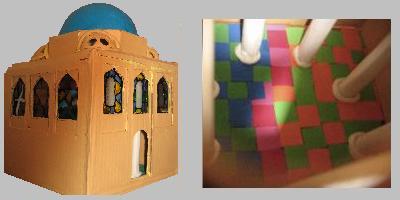
2. My 7-year-old daughter and I have constructed what we call our “mosque.” It is about 14 inches high. It isn’t really a mosque, because it lacks a mihrab (to orient people for prayer) or a minbar (the Islamic equivalent of a pulpit). That’s probably just as well; it might seem disrespectful for two unbelievers to build a mosque for play. Our motives were the opposite of disrespectful. We (or at least I) love Islamic architecture and wanted to figure out how to construct a public building–which could be a bath, a school, or a library–in the 16th-century Ottoman style.

3. In the 1990s, I used to play the clavichord. It is one of the two quietest instruments I know, the other one being the lute. If an air-conditioner is running in the same room with our clavichord, you can’t hear a note from more than three feet away. Its low volume was an attraction for me, because we live in a small apartment. So was the fact that J.S. Bach would have used a clavichord in his home. Tuning it, however, is so time-consuming that I have mostly given it up. (I did receive a didgeridoo for Christmas last year, but that’s mostly for looking at.)

4. I basically identify as a Jewish American, a grandchild of immigrants. But it turns out that my oldest American ancestor, by way of my mother, was one Isaac Learnard, who died in Chelmsford, Mass. anno domini 1657.

5. I am color-blind and can hardly sing a note. (Or, even worse, I can only sing one note.) Yet I love music and painting. Would I enjoy these arts less if I could actually perceive them?

I tap phronesisaical.