Author Archives: Peter Levine

efficiency versus “receptivity” in politics

I’m just back from a meeting on how to mobilize young people to vote. Techniques for that purpose are becoming increasingly sophisticated. In the 1990s, you might just mail people flyers reminding them to register. Then organizations began to test various messages with focus groups before they printed their flyers. Now they do true experiments, randomly selecting some addresses to receive one flyer instead of another and keeping track of the response rates. (The most effective messages often perform worst in focus groups.) This is just an example of growing efficiency in public-interest or nonpartisan politics. The end–maximizing the number of voters between the age of 18 and 25–is generally taken for granted.

I should emphasize that my organization, CIRCLE, has funded and organized such experiments and collected the results in a user-friendly document (pdf).

Meanwhile, back in my hotel room, I was reading Romand Coles’ article entitled “Moving Democracy: Industrial Areas Foundation Social Movements and the Political Arts of Listening, Traveling, and Tabling” (Political Theory, 2004). Coles argues that democracy means more than participating and expressing opinions (e.g., by voting). He emphasizes listening or “receptivity.” Listening is a source of power–you can strengthen your networks by being attentive to others. But it is also an ethical stance; it opens the possibility that you might need to change your ends, your interests, and even your identity. Coles goes on to argue that literally listening is not enough. You have to move your body to other people’s environments. “It is very easy, when the other [person] is speaking from a place–or places–you have never inhabited nor experienced them inhabiting, to shed inadvertently all too many of their words, expressions, and gestures, or to fail to absorb their depth, register their weight, and taste them, or to dismiss them altogether.” By “tabling,” Coles refers to the practice of literally moving the discussion table around from venue to venue within a community.

Sitting at the table at Wingsread, looking at data on dollar spent per vote cast, I was constantly struck by the contrast.
a growing class gap and the transition to adulthood

(Milwaukee) Life has changed substantially since 1975 for middle-class young people. Life has changed much less–and in less favorable ways–for working-class kids. The result is a growing class gap that influences the way that people become citizens.

For children of the middle class, the first two and a half decades of life are now devoted to “concerted cultivation” (Annette Lareau’s phrase). People are spending more years in college and graduate school. Their non-school hours are heavily programmed, from nursery school on, with soccer camps, music classes, internships, and travel. The age of marriage and first pregnancy is much delayed, and many 20-somethings are still living at home. Rates of drug and alcohol abuse have fallen. Parents and other institutions are making intensive investments in these young people’s human capital–their capacity to compete in a global marketplace. It makes sense to me that activities such as voting and joining community organizations are simply being delayed, along with home-ownership, fertility, and graduation from the final stage of education.

On several occasions, I have heard marketing experts describe all of today’s young people in these terms. The Millennials are said to be sophisticated, savvy, but also verging on spoiled–unsatisfied with courses and jobs that aren’t highly stimulating and educational. The Millennials are also depicted as tolerant and comfortable with diversity.

There is a large element of class bias in these descriptions. One third of American adolesents do not complete high school, let alone graduate school. Public schools are somewhat more racially segregated than they were in the 1970s, so plenty of working-class rural and urban youth have little direct experience with racial diversity. There are precious few after-school opportunities in poor neighborhoods or chances for poor adolescents to interact constructively with adults. The age of first pregnancy has not been delayed, but rates of incarceration are sharply up.

Given this widening gap in formative experiences, it is not surprising that there is a growing disparity in civic engagement by class. In its 2006 report entitled Broken Engagement, the National Conference on Citizenship found (using data analyzed by CIRCLE) that there had been a steep decline in the proportion of Americans who said that they had “worked on a community project within the last year.” But the bulk of the decline had occurred among people without college degrees. “College graduates dominate everyday American community life; high school dropouts are almost completely missing. Half of the Americans who attend club meetings—and half of those who say they work on community projects—are college graduates today. Only 3 percent of these active citizens are high-school dropouts. Thirty years ago, the situation was very different. In 1975, only about one in five active participants was a college graduate, while more than one in ten was a high school dropout.”

volunteering down in 2006

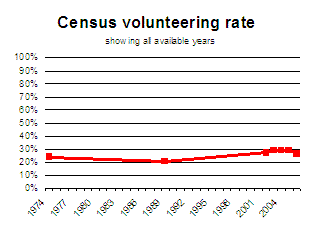
(from Wingspread, near Racine, WI) According to the Bureau of Labor Statistics, the volunteering rate for the United States as a whole slipped by 2.1 percentage points in 2006, having been stable for the previous three years. The Bureau adds, “The largest decline was among teenagers.” This trend matches our surveys from 2002 and 2006, which showed a decline in youth volunteering after a long and substantial increase during the 1990s. The BLS and other federal agencies are not making much of the 2006 results, which appear on an obscure web page. That makes an interesting contrast with 2005, when the Corporation for National and Community Service announced: “Volunteering Hits a 30-Year High, New Federal Report Finds.” As a matter of fact, the rate had not increased in 2005 compared to the plateau of the previous two years:

And now we see a decrease. For my part, I’m not convinced that the rate of volunteering is an important indicator. It tells us nothing about the seriousness of the work being done; and it arbitrarily excludes paid work of public value. I much prefer such questions as: “Have you worked with others to address a community problem?” But if we are going to draw a lot of attention to an increase in the volunteering rate (David Eisner called the level in 2005 “a once-in-a-generation opportunity to get more Americans engaged in making their communities stronger”), then we ought to pay equal attention to a decline.

privilege, giving way slowly

Joseph Palmi: The Irish have their homeland. Us Italians have our families and our

church; the Jews their traditions–hell even the [anti-Black slur] have their music; so what do you people have?

Edward Wilson: We have the United States of America. The rest of you are just visiting.

That’s an exchange from The Good Shepherd, Robert de Niro’s movie about the origins of the CIA. Edward Wilson is a spy whose career begins in Yale’s most famous secret society, Skull & Bones. Joseph Palmi is a Miami gangster whom Wilson will ask to murder Fidel Castro. If we take for granted the premise of the story–that a WASP elite once ran Skull & Bones, Yale, and the CIA–it’s interesting to ask why things have changed. Yale is a private institution with a self-perpetuating board. Outsiders cannot vote unless they are invited in. The alumni have contributed Yale’s $15 billion endowment and want their own kids to attend. Nevertheless, the place is no longer dominated by rich WASP families, lineal descendents of Edward Wilson’s classmates. To be sure, the faculty remains about 90 percent white, and just one in four students is a minority, But the current president is named Levin, and his predecessor who presided when I arrived 21 years ago was one Angelo (“Bart”) Giamatti. Why did families like Edward Wilson’s cede any ground at all?

Continue reading

problems with “stakeholders”

Today, my colleagues and I discussed a paper on assisted human reproduction in Canada. In passing, we learned that the Royal Commission on New Reproductive Technologies “took advice from about 40,000 individuals and organizations with interest [sic] in the matter”–collectively known as the “stakeholders.” Consulting stakeholders is a popular way to enhance the quality and legitimacy of state decisions. It is most often used in the writing of regulations. Laws are written by legislatures, which claim legitimacy on the ground that their members have been elected. But laws always require detailed regulations; and regulators are not elected. Rulemakers and administrators appear more democratic if they consult “the stakeholders” before they make decisions.

Another phrase for “stakeholder” is “interest group.” Whereas consulting people who have “stakes” in a given matter sounds wise, giving access to interest groups sounds problematic. Indeed, consulting organized interests raises several concerns:

1. A set of interest-group representatives (no matter how numerous) will not represent the whole population. To form an organization takes resources. Thus people with more money will have more interest-groups per capita. Also, people whose interests are more clearly defined and pressing will be more likely to organize themselves. For example, there may be lobbies for various types of medical specialists, but only a weak lobby for patients. Diffuse and subtle interests may be completely lost. For instance, as consumers of food, we might have interests when the government is considering health regulations. (Maybe more state funding for in-vitro fertilization means less funding for agricultural research.) But it is unlikely that a lobby would form to represent the health-policy interests of eaters.

2. Because of the “Iron Law of Oligarchy,” the representatives of interest groups may not reflect the opinions of their own members. For example, someone who claims to represent thousands of nurses may not share the views of average actual nurses.

3. Most “stakeholders” arrive with instructions from their organizations. Sometimes those instructions are rather narrow. For instance, a stakeholder may work for a firm with a fiduciary obligation to maximize returns for its shareholders. When people hold rigid but conflicting instructions, they have trouble deliberating as a group. They may negotiate to get the best possible deal, but they cannot learn or change their aims in response to principled arguments. Faced with conflicting demands, public officials may well try to “split the difference.” The result is policymaking as bargaining.

4. Impressing policymakers takes skill. The relevant skills are for sale. Groups with more money will have better powerpoint presentations, more timely polling data, a better grasp of the regulatory timetable and process, more contacts with other groups, and so on. Thus they will tend to prevail.

There are two alternatives to stakeholder consultations–neither of them foolproof. One is to force legislatures to make all the really serious and controversial choices. The other option is to delegate decisions to regulatory agencies but require them to consult representative samples of the public.

[Two classic treatments of this problem are Theodore Lowi’s The End of Liberalism (1969) and Robert Reich’s “Policy Making in a Democracy,” a chapter in his 1990 edited volume The Power of Public Ideas.]