Author Archives: Peter Levine

campaign finance: defining deviancy down

It isn’t easy to regulate or control money in politics. There are practical problems: money tends to seep around legal limits. There are big political obstacles: everyone who holds elected office won the last race under the existing system and has an interest in preserving it. And there are constitutional objections. Even if one feels that the First Amendment allows the government to limit direct contributions to candidates, independent communications still constitute protected free speech.

Nevertheless, the government should not be for sale. We should feel at least some discomfort every time private funds flow into accounts that benefit candidates for public office. If politicians are a little embarrassed to rely on wealthy donors, there is at least a check on their behavior–a felt need to set limits or make amends. We can thereby retain a sense that the market and government are separate spheres of justice.

But shame now seems to be antiquated. According to Adam Nagourney in the New York Times (January 9):

Over 400 people, including corporate executives, governors, wealthy Republican donors and party operatives, gathered around telephones and computer screens stretched out over a huge convention center room for a day of public fund-raising on behalf of Mitt Romney, the former Massachusetts governor who created a presidential exploratory committee last week. Television camera crews and reporters circled the room as Mr. Romney’s aides provided a running tally of how much had been raised.

For Mr. Romney, this high-tech fund-raiser, with new fund-raising software rolled out to mark the occasion, amounted to a public declaration for the White House, as he marched out with his family for his first major event since leaving the Statehouse.

And as Mr. Romney announced at day’s end that he had drawn a $6.5 million one-day haul in cash and commitments, it was also a striking example of just how important fund-raising has become as a test for presidential viability, this year more than most, with the race dominated by high-profile candidates, most of whom are unlikely to participate in the public financing system.

”This has never been done before,” Mr. Romney said, standing in the middle of an elaborate set, a wireless microphone planted on his body. ”This is the most advanced technology ever employed as a fund-raising effort.”

Instead of announcing his presidential campaign in front of Bunker Hill or the USS Constitution, the former Massachussets governor deliberately chose a bank of fundraisers as a symbolic backdrop. In this presidential season, privately-funded campaign spending is expected to top $1 billion for the first time. The only hope is that such blatant, unashamed mixing of money and politics will provoke revulsion.

[p.s., I note that Senator Obama, who will certainly raise plenty of cash, has imposed a limit on himself. He won’t take money from registered federal lobbyists. That is hardly an adequate solution to the overall problem, but it reflects an old-fashioned sense that private money is problematic in politics.]
the hookup culture (II)

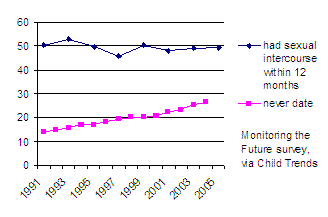
In a comment to yesterday’s post on the “hookup culture,” Mike Weiksner asks whether this is a new phenomenon. I don’t know for sure, but I find two trends interesting: the rate of sexual intercourse is basically flat, but the percentage of adolescents who “never date” has almost doubled. (Trends are shown for 12th graders.)

This graph is consistent with the idea that “hooking up” is replacing “dating.” But it raises several questions that I cannot answer without obtaining direct access to the data. (It would also be very useful to add other survey items.) What proportion of the young people who “never date” have sex? What would the trend look like for sexual behavior other than intercourse? What are the mean numbers of sexual partners for those who do and do not “date”?

the hookup culture

Those who are responsible for adolescents and college students are worried about the “hookup culture.” Quite a few young people have sex frequently with different partners within the same large social network. Their choice not to repeat sex with the same partner seems deliberate, probably a way to avoid commitment.

I think the hookup culture is new and troubling. It’s an example of treating other people merely as means, not as ends in themselves. Participants must constantly estimate their own desirability as sexual partners based on their success in the hookup market. That seems stressful and likely to cause pathologies, such as eating disorders. Because we have a natural proclivity to become emotionally connected to our sexual partners, people who “hook up” are likely to use drugs or alcohol to suppress those feelings. Finally, these young people are missing an opportunity to practice intimacy. I worry that when they actually try to settle down with a partner and start a household or a family, they won’t be good at it.

No doubt, this phenomenon has several causes. I suspect that one of them is economic. Young people are coming of age at a time of high risk and high opportunity, when they feel that they need lots of “human capital” to compete in the job market. They want as many experiences and awards as they can obtain to list on their resumes. Human entanglements don’t help, and an emotional relationship might hold someone back.

The deepest problem may be that successful students now do everything (studying, volunteering, exercise, and sex) for instrumental reasons: to prepare themselves for the moment when they graduate from their final level of college. I worry that they are going to find young adulthood very disappointing, and they will regret missing the chance to do things for their own sake.

I would guess that quite a few participants in the hookup culture (especially young women) are actually rather discontented with it. But it would take collective action and reflection to change that culture. Adults are poorly placed to take this on, because our questions are likely to be seen as censorious. (Or we may seem to be challenging freedom and sexual equality.) Although we should stand ready to help, the Millennials themselves will have to deal with this problem, much as previous generations changed gender roles and sexual mores.

[PS See the Washington Post’s excerpt from Laura Sessions Stepp’s new book Unhooked, which includes this quote from a young woman who is afraid to fall in love:

Her number-one goal, for as long as she could remember, was to excel in school so that she might someday land a great job that would make her financially independent. In high school, she maintained an A average, played volleyball and rowed crew, edited the digital yearbook and played on a church basketball team that won the state championship. Her pace in college was similarly brisk, and she didn’t see how, even in her senior year, she could afford to invest time, energy and emotion in a loving relationship.

At her 21st birthday party she talked about this with a girlfriend who understood. As the friend said, over the recorded sounds of rapper Jay-Z, “I don’t have time or energy to worry about a ‘we.’ “

This concern for financial independence (not affluence) seems symptomatic of a high-risk/ high-opportunity economy that provides weak social supports.]

benefits of service-learning and student government

(Durham, NC): My colleagues and I argue that civic experiences in adolescence make young people into active, effective, and responsible citizens–participants in politics and civil society. However, most students, parents, teachers, administrators, and policymakers are less concerned about civic education than about getting kids successfully through high school and college. Their priorities are understandable. One third of adolescents do not graduate from high school, and those who drop out face very bad prospects. Thus I’m delighted to announce new research showing that two civic experiences–service-learning and student government–substantially increase the odds that students will complete high school and college on time. Presumably, we can enhance adolescents’ motivations and sense of connection to school by giving them opportunities to serve and lead. (These are results from two new CIRCLE working papers by Alberto Dávila and Marie T. Mora.)

lordy, lordy

(en route to Durham, NC). Yesterday, I turned forty. Since I happen to have a sick parent right now, “intimations of mortality” would be an understatement. Last time I noticed, my contemporaries were deciding what advanced degrees to pursue, looking for spouses and partners, and wondering whether our elders were paying any attention to us. Now we worry about our own kids, our parents, and our savings; and we are the elders in some of our institutions. All my Gen-X friends seem to live in grown-ups’ houses and understand grown-ups’ issues like 401(k)s, renovations, and dinner parties. We used to play at adult roles; now we inhabit them. Each day, the world seems exactly like yesterday, but a “heap” of days passes and life is completely different.