Author Archives: Peter Levine

beyond voting

Numerous nonprofit groups are involved in mobilizing people to vote–usually focusing on poor, young, or minority Americans, who are least likely to participate. Other organizations fight legal barriers to voting. Often their objectives are progressive: they seek greater political equality so that policies will be more just. I certainly share these objectives, but I argue that we must look beyond voting and also consider how people directly address problems at the local level. Working on PTAs, tenants’ associations, and community development corporations; restoring ecosystems; organizing anti-crime patrols; and maintaining community websites are examples of fundamental democratic work.

1) We need such local, participatory efforts to address our deepest problems in areas like education, crime, the environment, and economic development. Large governmental institutions cannot solve these problems unless there is also strong local participation.

For instance, Harvard professor Robert Putnam finds that the level of adult participation in communities correlates powerfully with high school graduation rates, SAT scores, and other indicators of educational success at the state level. “States where citizens meet, join, vote, and trust in unusual measure boast consistently higher educational performance than states where citizens are less engaged with civic and community life.” Putnam finds that such engagement is “by far” a bigger correlate of educational outcomes than is spending on education, teachers’ salaries, class size, or demographics. (Robert D. Putnam, “Community-Based Social Capital and Educational Performance,” in Diane Ravitch and Joseph P. Viteritti, eds., Making Good Citizens: Education and Civil Society (New Haven: Yale University Press, 2001), pp. 69-72.)

2) There are big and widening gaps in local participation by social class. Therefore, anyone concerned about equity in our democracy must worry about participation in local community work, not just voting.

In the following graph, the dark blue line shows attendance at meetings for people with college degrees; the light blue line shows people without high school diplomas. The latter group is almost completely gone from civil society.
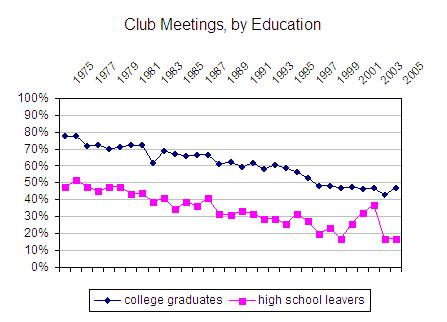
Put another way, half of the Americans who attend club meetings–and half of those who say they work on community projects–are college graduates today. Only 3 percent of these active citizens are high-school dropouts.

3) Voting isn’t attractive unless it emerges out of other forms of participation that give people information, confidence, motivation, and a feeling of connection to the community. People who vote are usually also members of groups and networks, community volunteers, and consumers of news media.

According to the 2000 National Election Study, there were strong positive correlations among reading the newspaper, volunteering, working on a community issue, contacting a public official; attending a community meeting; belonging to associations; and voting. To illustrate the relationships with an example: 42.4 percent of daily newspaper readers belonged to at least one association, compared to 19.4 percent of people who read no issues of a newspaper in a typical week.

4) Americans will not vote in favor of governmental programs, funded with their tax dollars, unless they believe that they can influence and collaborate with government institutions such as schools and the police. Therefore, progressives should be very eager to increase local participation.

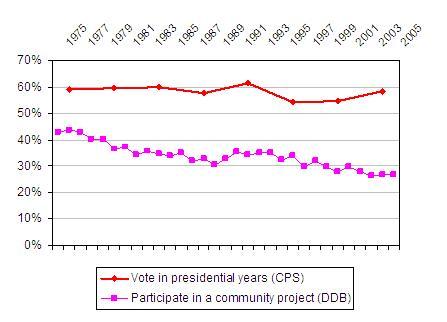
5) There has been no consistent decline in turnout since the early 1970s. (The voting rate is always too low, but it rises and falls depending on the issues of the day and the performance of major politicians.) However, there has been a consistent decline in local problem-solving and collaboration.
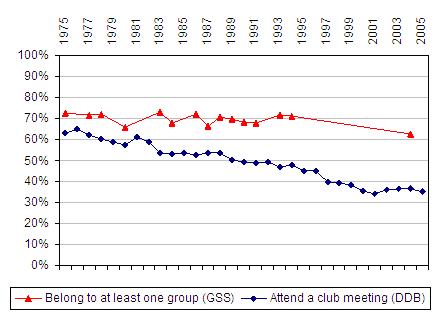
6) Probably one reason for the decline in face-to-face, public work at the local level is the change in the nature of our organizations. Theda Skocpol argues that non-participatory groups are replacing participatory ones. The graph below reinforces her finding. The red line shows that membership in groups is modestly down, but attending a meeting has declined much more substantially. In other words, people still join associations, but the groups they join don’t involve meetings. That means that people have less voice in civil society.
7) Despite the decline in the proportion of people involved in local problem-solving and hands-on work, this sector is very innovative and has great potential for growth. We see all kinds of successful projects, ranging from community blogs to the “21st Century Town Meetings” recently conducted in New Orleans; from youth advisory commissions to whole urban neighborhoods that have been rebuilt by church groups.

For examples and case studies, see Cynthia Gibson, Citizens at the Center (Case Foundation White Paper, Carmen Sirianni and Lewis Friedland, The Civic Renewal Movement: Community Building and Democracy in the U.S (Dayton: Kettering Foundation Press, 2005), Archon Fung and Erik Olin Wright, Deepening Democracy: Institutional Innovations in Empowered Participatory Governance, and Community-Wealth.org.

If the premises presented above make sense, they imply that we need more collaboration among voting rights groups, groups that mobilize citizens to vote, and groups that promote civic innovation and collaboration at the local level. We should devote attention not only to inequalities and barriers in the formal political system, but also to other trends that may cut citizens out of public life. Two examples are the professionalization of advocacy and the excessive deference given to expertise in areas such as education, the environment, and economic development.

Finally, we need to consider policy reforms that take seriously the capacity of citizens to address problems. These reforms should go beyond thin conceptions of citizenship such as we see with the national service programs (Americorps and the like). Examples are here.

academic freedom and accountability

More than a week ago, Harry Brighouse wrote a Crooked Timber post entitled “What’s the point of academic freedom?” It provoked a lively, focused, and intelligent discussion. One of Harry’s main points was that academic freedom is not primarily a matter of individual autonomy. Universities, disciplines, and academic departments control what is taught, what is published, what work qualifies advanced students for degrees, what research is funded, who is hired, promoted, and tenured, who is invited to speak publicly, and on what topics. In all these respects, academia as a set of institutions constrains the free speech rights of individual academics when they are on the job.

The main questions, therefore, are: (1) To what extent should academic institutions be autonomous–collectively-self governing? (The alternative is for some outside power, such as the state government, to regulate them). (2) How should academia govern itself? For example, should the faculty of a whole university (which combines many disciplines) influence tenure decisions within a particular department? (3) To what extent should academic institutions decide to govern themselves by granting maximum individual autonomy to professors over such matters as course topics? To what extent should the internal norms of academia be libertarian, as opposed to meritocratic, egalitarian, or communitarian?

Much of the discussion in the comments thread favored institutional autonomy for academia on the grounds, first, that outsiders lack the expertise to make judgments of quality, and second, that politicians and students have untrustworthy agendas. The examples that arose include medieval studies, philosophy of language, and Victorian English literature. In these cases, research costs relatively little (thus is can be sustained with tuition money). Such research has relatively little impact on public policy or public issues. And such research can be particularly technical and hard for outsiders to judge properly. Thus it seems unnecessary and unwise for outsiders, such as politicians, to try to influence how these disciplines are practiced.

But the core liberal arts represent only a small fraction of academia. Some professors are engaged in pure research that is very costly, requiring particle accelerators or massive door-to-door surveys. These researchers are surely accountable to the taxpayers or foundations who fund their work. Even if legislators cannot understand particle physics, they must make judgments about whether it is worth money that could otherwise be spent on child health or returned to taxpayers. There is no expertise on that essentially moral matter, which is for the public and its representatives to decide.

Other professors teach and study fields like elementary education, accounting, marketing, planning, forestry, law, public health, librarianship, and nursing. These fields have direct relevance to public institutions and policies. For example, planners actually determine the shape of our cities; education professors profoundly influence aspects of our public schools. Academics are also gatekeepers to licensed professions, such as law and teaching, that are very powerful within the state sector; in this respect, their political power is evident and direct.

The expertise that these professions develop is at least partly problematic. For example, it is good to have rigorous, quantitative research on education. But it is also crucial for parents and other citizens to judge what their schools are doing and why. If education becomes dominated by highly technical jargon, our schools are no longer genuinely “public.” Genuinely public schools are ones in which many adults participate and influence the outcomes and norms. Participatory schools work better than others, but that is not the main point. The main point is that people have a right to shape the education of the next generation.

If one starts with the example of a philosopher of language, writing a paper in her own home after teaching classes to pay her salary, the arguments for academic autonomy are at their zenith. As one commenter writes, such “professors only answer to other professors.” But if one starts with a professor of educational administration or urban planning, I think it’s pretty obvious that the public has some rights of oversight and review. How exactly that should be exercised is a more complicated question.

the actually engaged citizen

I basically just write about civic engagement. My wife actually engages. She’s the “Laura” who appears in this front-page lead of a story in The (Washington, DC) Northwest Current. The article, by Ian Thoms, begins:

The mayor’s school takeover plan colored much of the discussion at last week’s District II school board forum in Cleveland Park, but it was the final question of the night that hit the issue right on the head.

John Eaton Elementary parent Laura Broach asked the question that had been lurking behind most of the night’s queries. Given the greatly reduced role of the board under the mayor’s seemingly soon-to-be-approved legislation, why do the candidates still want the job?

The pending legislation will take budget authority away from the school board and give it to the city council, while transferring day-to-day management to the mayor. The school board will be left to decide some matters of curriculum and standards. I don’t see a matter of high principle here, since the same electorate chooses all three bodies. It remains to be seen whether rearranging authority makes any difference at all; I doubt it will solve our system’s problems, which are very deep. Public participation is a big part of the solution, and the local school board forum was a good example.

the Jane Addams School

Voices of Hope is a new book by Nan Kari and Nan Skelton. It looks very handsome in its published form, richly illustrated. I read it in typescript (with no photos) in order to produce the following blurb: “Voices of Hope is an essential contribution to the debate about public education in America. Its subject, the Jane Addams School for Democracy, does not belong to the government. It is not a nonprofit corporation. It does not grant diplomas or give grades. Yet, in a profound sense, it is a ‘public school,’ a model of what happens when Americans of all ages and backgrounds come together voluntarily to create knowledge, understanding, and power. The spirit of Hull House and the civil rights movement’s citizenship schools is still alive in Minnesota today and deserves our careful attention.”

I visited the Jane Addams School for Democracy in 2001 and returned with the goal of helping to do something similar in Maryland. (This post recalls my experience.)

my home as described by Stephen Dunn

(Syracuse, NY) We’re visiting my parents in the house where I grew up. It’s a cottage on the top of a steep hill. The back yard leads into a large urban park: nicely landscaped with meadows and stands of cypress trees, but always somewhat dangerous. Inside, as I’ve noted before, there are almost 30,000 books. Wherever there are spaces over bookcases or on the stairwells, my parents have hung prints. These are mostly rather sedate works–but on the steps to the attic hangs a Kathe Kollwitz engraving of Death or the Devil dragging a mother away from her baby. The furniture in the living room was once upholstered in white leather.

All this is background to a poem that Stephen Dunn wrote when his family rented the house from us. I think this must have been 1973-4, when Dunn was a visiting professor at Syracuse University and we were in London. The poem, typed on a real typewriter that bit into the paper, reads:

Letter to a Distant Landlord

This is the 20th century and you

are invisible, across the Atlantic,

beyond reach. We sleep in your bed,

we make love where

you made love and it’s strange

we’ve not met.

This house, though, does speak

of you; all the books, the good

junk in the attic, that

startling print in the upstairs hall.

You’ve brought the past forward

to mingle like a fine, old grandfather

with the appliances and dust.

And we approve.

Even the ghosts here are intelligent.

They wait til the children are asleep

then sit in the white chairs

in the livingroom. Some nights

it’s Nietzsche, last night it was

Marx. They are all timbre

and smoke, all they want is

for me to get off my ass, to break

my spririt’s sleep.

But they don’t insist. They’ve seen

so much their rancor has turned

to sighs. We do not learn

is what they’ve learned.

Yet we are comfortable in your house.

It is what we wanted.

The park nearby is beautiful

and dangerous, a 20th century park,

the kind we must walk through. Our small

belligerent dog picks fights there

with Shepherds. They pick fights with him.

Sometimes though they’re all tails and tongues,

like us, and the air smells good

and the grass is freshly cut.

And so we send our checks

and try to imagine your hands,

your face, the way you discuss

the things you must discuss.

Some day after you’re back,

smelling our smells and rearranging

your lives, maybe we’ll appear

at your door disguised as ourselves.

We’ll say we’re looking for a house

(that’ll be our only hint), sneak

the glimpses we want, and move on

like strangers who brushed by

on their way somewhere else

and don’t know why, in this century,

they cannot stop.

I love this poem as an evocation of my home, Dunn’s private life, and the 20th century. I’d only quarrel with one aspect (and even on this point I grant Dunn his license). I doubt that the ghosts in our house talk about Nieztsche and Marx very often. There are shelves of books by those authors that might conjure their spirits once in a while, but I’m sure they don’t reign over the house. The local spirits are English, bewigged, dusty, and interested in facts rather than theories.