Author Archives: Peter Levine

trust and participation

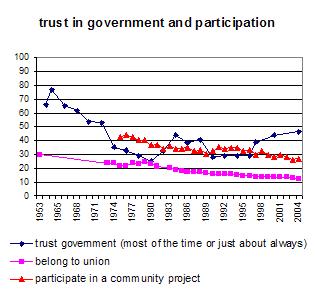
This is just to illustrate my argument from last Wednesday. I claimed that we cannot have massive new government programs without public trust, unless the programs are very simple and transparent–which is virtually impossible in the case of health care. The necessary trust has eroded, in part because people don’t belong to participatory groups that seek their voluntary support and that influence the state. Unions are a major example of such groups.

This graph cannot demonstrate a causal relationship among the three trends: falling trust, declining union membership, and declining participation at the local level. But I hypothesize a connection.

By the way, this graph is my belated response to a comment by David Moore, which I had missed.

stay tuned

Th Ad Council and the Federal Voting Assistance Program are launching public service announcements (also known as TV ads) “to promote youth civic engagement. … An extension of their ongoing campaign to encourage young adults to exercise their right to vote, the new PSAs urge young adults to become involved in their communities by voting, volunteering and becoming informed about current events.” The press release cites our 2006 survey:

According to FVAP, during the last twenty-five years there has been a dramatic decrease in voter turnout among 18-24 year-olds. In addition, a 2002 report conducted by The Center for Information & Research on Civic Learning & Engagement [CIRCLE] found that 57 percent of American youth aged 15-25 are completely disengaged from civic life and politics.

lessons from the health care defeat

At the Democratic presidential debate in South Carolina, the candidates were asked: “What is the most significant political or professional mistake you have made in the past four years? And what, if anything, did you learn from this mistake which makes you a better candidate?” Senator Clinton replied: “Certainly, the mistakes I made around health care were deeply troubling to me and interfered with our ability to get our message out.”

I would love to know what mistakes she thinks she made and what she learned from them. I would be sincerely interested in her full response–if she could give it candidly–because she is highly intelligent and experienced and she has a unique perspective as organizer of the 1993 health care reform effort. We cannot know for sure, but I suspect she would disagree with my interpretation, which is the following. …

The 1993 health reform proposal represented a particular kind of liberalism which is dead. The proposed system would have required an enormous degree of public trust. The details were extremely complicated, so that people (certainly including me) could not understand them. The structure that Clinton proposed would have evolved and shifted as public-sector organizations negotiated with private insurers. Thus the details of the health plan were not only complex; they were unpredictable. Why then should citizens entrust thousands of their dollars per capita to the government? The implicit reasons were: 1) We (in the government) are more trustworthy than those greedy people in HMOs and insurance companies. 2) We will represent you because we are elected. We will act like an interest group in the marketplace, bargaining for advantage; but you will own us. And 3) We are extremely smart. Ira Magaziner is a Rhodes Scholar; we’ve known him since college days–he has a high IQ.

Those three arguments could work in 1935, when Roosevelt brought lots of talented Ivy Leaguers to Washington to create elaborate programs. It could work in those days because there was more deference to expertise, more hostility to business, and a deeper national emergency–but also because people belonged to institutions with which they had real contracts. They were members of local party organizations and unions that had to pay attention to them in return for their participation. In turn, the New Deal administration was accountable to the unions and the party organizations.

By 1993, that infrastructure was gone. Less than 15 percent of the private sector workforce belonged to unions, which seemed unaccountable even to their shrinking membership. The parties were not organizations at all, but collections of political entrepreneurs. Although we have very pressing reasons to distrust private health insurers, we also have reasons to distrust the government, which gives us urban police departments, the Iraq war, etc.

In the South Carolina debate, Senator Clinton mentioned “getting the message out.” I don’t think a better message for government-funded health care could work, under these conditions. I’d argue that we cannot have a national health care reform plan unless we use one of these strategies to earn public trust:

1) We could design a government-run system: for example, a single-payer insurance fund that actually set prices for health care. This would give the state enormous power, but also achieve huge savings. In order for people to trust it, they (or a large representative group of them) would have to be actively engaged in writing the law and then revising it. We would need an ambitious series of public deliberations involving a representative sample of citizens. As a charter member of the Deliberative Democracy Consortium and a board member of AmericaSpeaks (which organizes such processes), I’m hopeful that this approach could work. However, I must concede that we have no idea whether public deliberations could build trust for an enormously expensive program, especially if well-funded special interests bitterly attacked it.

2) We could rebuild participatory local institutions as the base for stronger government. That’s an attractive idea, but one that would take decades to achieve, if we could figure out how to do it at all.

3) We could have some simple and transparent system that was trustable because it was understandable. I don’t think that the government could set prices, because that is inevitably complex. Instead, the government would probably have to issue vouchers that people would use to buy insurance. Unfortunately, we would then be stuck with insurance-company profits and marketing costs.
“take back our citizenship”

I love this new project created by students at “the U” (the University of Minnesota). They say: “Our goal isn’t to get you out to vote. It isn’t to support one candidate or another. Our goal is to get you to think about what it means to be a citizen in this country and to think about what role you would like to play. We’ve seen the power that citizens can have if they choose to take it, and we want you to take it.”

strategy, scholarship, and passion

Three meetings in the last four days have reminded me of our wonderful human diversity, even though the participants spoke the same language, gathered in similar settings in two cities along our East Coast, and addressed similar topics.

On Thursday, I spoke to a group of human rights activists from the developing world. Their host was the State Department; the setting was a private room in a Washington restaurant of the old, steak-and-bourbon style. I talked about civil society and the kind of politics that begins with citizens, not with governments. Much more interesting than I were the visitors who formed my small audience. There were West African politicians who delivered relatively long and formal comments, standing up to address the room. One man from Nigeria laced his remarks with classical allusions. An Egyptian and a Lebanese, speaking separately, criticized American foreign policy, particularly our inconsistent support for democracy. They were polite but passionate and angry. Afterwards, they asked to have their pictures taken with me, joking that my career as a politician would now be doomed. (It wasn’t going anywhere before then.) The Lebanese man complained that US funding agencies want more youth civic engagement in his country. He noted that every young Lebanese took to the streets in protest last summer. Youth engagement is not the problem; governments are.

On Friday and Saturday morning, I participated in a small academic conference on youth civic engagement. My colleagues were mostly psychologists. We sat around a seminar table in a slightly beat-up room high in a skyscraper that belongs to Fordham University. One of our characteristic ways of communicating was to respond favorably to the previous speaker’s remarks, adding: “So-and-so from Harvard–or Indiana, or Loyola–has done work on that.” Or: “There was a piece about that in ADS in the early nineties.” Or: “MTF data show that trend.” Because everyone was an empiricist, the norm was to ground claims in facts and statistics. Yet the participants shared strong, implicit moral commitments: to the dignity and value of political participation, the need for equality and justice, and the positive potential of young Americans. Therefore, much of the evidence came from evaluations of highly idealistic programs that were relatively small. The real message was how much young people could achieve if big institutions invested in them.

iThen, on Saturday evening, I joined the Newspaper Association of America (NAA) conference at Tavern on the Green in Central Park. This was a big institution with funds to invest. The participants were American media executives: prosperous, confident, good-humored and jocular. It was like an Ivy League alumni reunion, albeit with more women that you would see if the Princeton class of ’65 reconvened. I was served an enormous piece of beef while speakers stood to roast one another.

The next day, as a trustee of the NAA’s Foundation, I heard a presentation on youth. The speaker was a market researcher, and his objective was to help newspapers reach young consumers. This is a worthy goal, because we know that newspaper readers are much more active in politics and community affairs. Of course, the motives of the newspaper executives are pecuniary, but that is fine: they could achieve public benefits by investing in young readers

The presenter sounded like a motivational speaker. (“Folks, you’re going to have to reach them where they are.”) He had six main ideas about young Americans, and each one had its own, professionally designed logo that flashed on the screen. (For instance: “autono-ME” meant the strong desire of young consumers to customize their products.) These aspects of the presentation certainly put me off, but it was quite insightful and based on statistical evidence. It was also rather disturbing, since a picture emerged of young people who are tremendously skillful at finding entertainment that has little public or intellectual or spiritual value. My only doubt about the factual claims in the presentation concerned the future. Generations develop over time. The same people who wore dashikis and love beads in 1968 had been Eisenhower-era suburban kids in 1958. So there is always the possibility that today’s teens will rebel or shift dramatically–especially if they encounter passionate arguments like those I heard on Thursday or excellent programs like those discussed on Friday and Saturday.

It’s a facile conclusion, but I’ll write it anyway. We must somehow combine the political commitment and groundedness of the State Department’s visitors with the idealism and empirical rigor of the developmental psychologists and the economic muscle and realism of the media industry.