Author Archives: Peter Levine

round Charlotte Bronte’s thumb

(Written at 30,000 feet over the Rockies, en route to San Francisco, after finishing Jane Eyre)

If Jane Eyre really were what it purports to be–the “autobiography” of someone of that name, as “edited” by Currer Bell–I think we would read it as follows. We would take it as the testimony of an individual who claims she has been helped by several good people but thwarted and controlled by quite a few bad ones. From her time as an orphan under Mrs. Reed, to her captivity at Lowood School, to her two near-marriages, Jane always feels she is being “mastered” (a frequent and significant word in the book) by others for their purposes, whether those are mercenary or pious. She submits until she revolts–for, as she observes:

    I know no medium; I never in my life have known any medium in my dealings with positive, hard characters, antagonistic to my own, between absolute submission and determined revolt. I have always faithfully observed the one, up to the very moment of bursting, sometimes with volcanic vehemence, into the other.

This is not quite true, because Jane also has a talent for skillful but well-motivated manipulation, especially in dealing with Rochester. Still, this passage captures the general pattern of the novel: submission followed by revolt or flight. What Jane ultimately attains is control, so that she can say, “Reader, I married him.” (Not: “Reader, he married me,” or even, “We were married.”)

If Jane Eyre’s testimony were true and complete, it would condemn half a dozen characters for their poor treatment of her: Mrs. Reed, Georgiana and Eliza Reed, Mr. Brocklehurst, Naomi Brocklehurst, Miss Scratcherd, Blanche Ingram, St John Rivers, and the still-sighted Rochester are some of the book’s many villains. But we would recall that all this testimony was coming from Jane, whose acknowledged faults are few and minor and deeply regretted. So I think we would resist the narration and seek other perspectives. Maybe Mrs. Reed had trials with little Jane that should excuse some of her perceived coldness.

In fact, Jane Eyre is not an autobiography. Mrs. Reed has no reality or perspective except what we can glean from the book. The dominant perspective–the choices that channel our emotional and moral responses–are all and only Charlotte Bronte’s.

By condemning Mrs. Reed, Mr. Brocklehurst, and St John Rivers, Bronte did not wrong those individuals, for they never lived. But Bronte also had real-life targets: uncharitable bourgeois women, hypocritical Calvinists, and men of great soul who enroll others for their noble purposes. Her fictional examples support a distinctive worldview, which surely includes the following elements: a passionate but unorthodox theism; fondness for domesticity and heterosexual romantic love; English patriotism with a dose of Francophobia and possibly racism; a very loosely Kantian insight that one should “enjoy [one’s] own faculties as well as … cultivate those of other people” (seen as twin duties); a feminism that resists patronizing and narrowing attitudes towards girls and women; and a measure of social egalitarianism, as captured by passages like this: “I must not forget that these coarsely clad little peasants [all girls] are of flesh and blood as good as the scions of gentlest genealogy; and that the germs of native excellence, refinement, intelligence, kind feeling, are as likely to exist in their hearts as in those of the best-born.”

Because the book is contrived to support a particular worldview, it has always elicited furious responses from holders of conflicting views. Victorian critics who defended Calvinism or social inequality denounced its alleged vulgarity. The Christian Remembrancer (June 1848) couldn’t believe that Mrs. Reed would die unrepetant; such a caustic depiction of a propertied Anglican lady showed “want of feeling.” Later, modernists disdained the novel for its theism and bourgeois domesticity. Although enduringly popular, Jane Eyre has been critically acclaimed only since the 1960s, when the feminist and generally liberating aspects of the book’s worldview were recognized (and its religious conclusion overlooked).

For myself, I find the worldview appealing enough, the story compelling, and Jane a likable character. What I resist is the contrivance of all the events and characters to reinforce one perspective. It doesn’t seem to me a polyphonic novel or one that explores tensions and conflicts among worthy values. Lady Frederick Cavenedish thought “the authoress turns oneself and one’s opinions round her thumb.” My very favorite novels are ones that let you loose.

[I take the quotes from The Christian Remembrancer and Cavendish from the Penguin edition’s introduction by Michael Mason–who is no relation, I assume, to Bertha.]
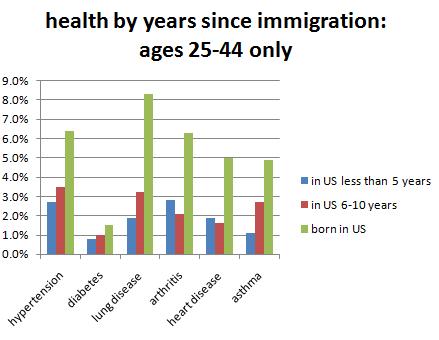
is immigrating to the US bad for your health?

In general, young immigrants (ages 18-44) have much better health than people who were born in the USA. But the more years pass after they immigrate, the worse their health becomes.

(adopted by Peter Levine from Guillermino Jasso, Douglas S. Massey, Mark R. Rosenzweig, and James P. Smith, “Immigrant Health and Acculturation,” in National Research Council, Critical Perspectives on Racial and Ethnic Differences in Late Life, 2004, table 7-6.)

I wouldn’t make too much of the above graph all by itself, but I was separately told by a well-informed colleague that there is a well documented “immigrant paradox.” Even as individuals grow more likely to have health insurance, stable employment, and stable housing, their health status falls towards the levels of native-born Americans of the same age.

It seems important to understand the reasons for this “paradox” so that we can improve the lives of large numbers of younger immigrants. Also, understanding why exposure to America seems to worsen health might reveal some important, general facts about life in America.

Not Even Past, from the historians at UT-Austin

I am impressed by “Not Even Past,” a brand new online history magazine that will present some new content every day. It is meant for lay readers but is produced by the History Department of the University of Texas-Austin: about 60 professors and their graduate students. Some appealing features include feature articles, mini-reviews of classic works of history, which explain their enduring relevance, and audio interviews. It is stylishly designed and well written.

I like the fact that it’s a collaborative effort by a whole academic department: that represents a different kind of work for professors, although fully compatible with their traditional practices. I like the relationship it creates between the public and a profession (for it reflects professional historians’ interests and methods but is meant for all intelligent readers and permits them to comment). Finally, although we are used to everything being free now, I like the fact that public employees have created material that is free of cost and of other barriers. They are contributing to the knowledge commons.

upside-down Foucault

Hypothesis: every space where Michael Foucault discovered the operation of power is also a venue for creativity, collaboration, and a deepening of human subjectivity.

By way of background: I respect Foucault as one of the greatest thinkers of the 20th century. Although deeply influenced by other writers and activists, he made his own crucial discoveries. In particular, he found power operating in places where it had been largely overlooked, such as clinics, classrooms, and projects of social science. Further, he understood that power is not just a matter of A deliberately making B do what A wants. It rather shapes all of our desires, goals, and beliefs. Its influence on beliefs suggests that knowledge and power are inseparable, so that even our understanding of power is determined by power. Despite the skeptical implications of Foucault’s epistemology, he struggled in an exemplary fashion to get the theory right, revising it constantly. He traveled a long intellectual road, directed by his own conscience and experience rather than any kind of careerism.

So it is as a kind of homage to Foucault that I suggest flipping his theory upside-down. Just as close, critical observation of people in routine settings can reveal the operations of power, so we can detect people developing, growing, reflecting, and collaborating voluntarily. To be sure, social contexts fall on a spectrum from dehumanizing to humanizing, with prisons at one end (not far from office cubicles), and artists’ ateliers at the other. But it would be just as wrong to interpret a whole society as a prison as to view it all as a jazz band. And, I would hypothesize, even in the modern US prison system–swollen in numbers, starved of resources for education and culture, plagued by rape and abuse, and racially biased–one could find evidence of creativity as well as power.

my blogaversary

I published my first blog post on January 8, 2003. Sunday will therefore mark my eighth full year of blogging. Today’s post is number 1,967. That’s equivalent to five posts per week for forty-nine weeks each year. I never post on weekends, so the actual blogaversary will pass in silence.

The medium has changed somewhat. In the early years, the only responses were emails, comments posted on my actual site (www.peterlevine.ws/mt), and other people’s blog posts that referred to mine. Locating such responses required ego-surfing, with search engines like Technorati.

Now my posts go forth in several ways: on my site, on my Facebook page, via Twitter, and via RSS feed. I also publish my more ambitious entries that have political themes on Huffington Post, where the number of comments is much higher. Facebook draws the most frequent and most civil and helpful comments. Twitter and RSS reach relevant audiences.

Fewer peers’ blogs now refer to mine, and I think that may be because fewer people are operating their own free-standing blogs. A higher proportion of the dialogue now is quasi-private–Facebook friends posting comments on my personal page–rather than blogs as an imitation of a “public sphere.”

I like Facebook, but I will hold onto my personal site because I want to control the archive of more than 1,900 entries. The vast majority of people who read anything on my blog are reading old entries that they find with Google searches. “Black dentists,” “Nabokov heroine,” and “Was Velazquez left-handed? are some frequent queries that land people on my site. (He was.)

Meanwhile, I think my content has been pretty consistent: the same mix of youth civic engagement, general politics from a “civic” angle, and bits of philosophy and literature. I generally try not to be self-referential, but the annual blogaversary is an excuse for summing up.