Author Archives: Peter Levine

Obama and the civic populist tradition

Harry Boyte recently had an epiphany looking at the map of where Senator Obama has won primaries or caucuses. Many Obama states–a band from Illinois across to Washington–have strong traditions of civic populism dating back to 1890-1939. Others were crucibles of the Civil Rights Movement in 1945-1970–a band from South Carolina to Louisiana. These were distinct movements but they had more connections than is often recognized. My favorite example is the way that Miles Horton went to Chicago to learn from Jane Addams before he started the Highlander Folk School in Tennessee, the center that helped train Rosa Parks, among many others. Nick Longo recovers this story in his book Why Community Matters.

Harry’s analysis is as persuasive as explanations based on demographics or primaries versus caucuses. His epiphany is relevant to the outcome of the current election. In states where there is a civic populist tradition, people hear Obama’s rhetoric in a particular way (like a “deep note vibrating in a base drum,” Harry writes). Obama says, “I’m asking you to believe. Not just in my ability to make change in Washington…I’m asking you to believe in yours.” People in states like Minnesota and Mississippi understand that it’s possible to unleash public energies to address serious public problems. So they presume that Obama is talking about public participation after the election–participation in our schools, parks, and neighborhoods.

In other places, however, Democratic voters do not have this frame of reference. When they hear, “We are the ones we’ve been waiting for” (a powerful echo of the Civil Rights Movement), they think that they are merely being asked to vote for Obama or to volunteer and give money to his campaign. In their minds, the campaign is the opportunity to participate–and they are not sure they want to join up. The aesthetic of hip-hop artists and starlets singing along to Obama speeches may not appeal to them. Some may share Joe Klein’s reaction (from TIME Magazine):

the campaign is entirely about Obama and his ability to inspire. Rather than focusing on any specific issue or cause–other than an amorphous desire for change–the message is becoming dangerously self-referential. The Obama campaign all too often is about how wonderful the Obama campaign is.

I don’t actually think that this is fair, but the perception inevitably arises when people don’t have experience with civic engagement. The smart strategy for the Obama campaign is to explain how President Obama will unleash the power of the American people after the election–how he will encourage Americans to cross differences and contribute their energies and talents to address social problems. That’s a concrete goal and it requires concrete policies and examples.
what publics do

In Publics and Counterpublics, the influential cultural critic Michael Warner writes,

All of the verbs for public agency are verbs for private reading, transposed upward to the aggregate of readers. Readers may scrutinize, ask, reject, opine, decide, judge, etc. Publics can do exactly these things. And nothing else. Publics, unlike mobs or crowds, remain incapable of any activity that cannot be expressed through such a verb. Activities of reading that do not fit the ideology of reading as silent, private, replicable decoding, curling up, mumbling, fantasizing, gesticulating, ventriloquizing, writing marginalia, etc. also find no place in public agency.

One one hand, Warner is right (and brilliantly astute) about the meaning of the word “public” in a certain literature, one in which the German theorist Jürgen Habermas plays a leading role. In this literature, the democratic public assesses, judges, opines, etc. All of this highly cognitive and verbal activity is much like reading–as we teach students to read in our schools and colleges. (It is not like reading in church, or reading a love letter.)

On the other hand, this whole literature misses functions of a democratic people that Tocqueville, Dewey, and many important current thinkers have emphasized (sometimes using the noun “public”). These functions cannot be performed by solitary readers, nor by the “mobs or crowds” mentioned by Warner. They include:

  • Founding and managing associations and institutions
  • Physically constructing public spaces
  • Creating and preserving stories, anecdotes, songs, and rhymes that reflect the culture
  • Raising children to be citizens
  • Filing lawsuits
  • Putting bodies on streets or across entrances to block traffic

I find the notion of “the public” as a body of judicious observers completely implausible, both politically and psychologically. What would motivate people to serve as detached “readers” of public issues? Why would powerful institutions honor their opinions, once they had gone to the trouble of forming them? And how would they obtain knowledge of issues if they never did any public work?

[Disclaimer: I have not yet read Publics and Counterpublics. I came across the passage quoted above in a fine article by Warner entitled “Uncritical Reading,” where he quotes his own book. A major theme of “Uncritical Reading” is the narrowness of our assumptions about how to read, e.g., our rule that one should always interpret passages in the context of whole books. Nevertheless, I must and shall read Publics and Counterpublics to grasp the whole argument.]

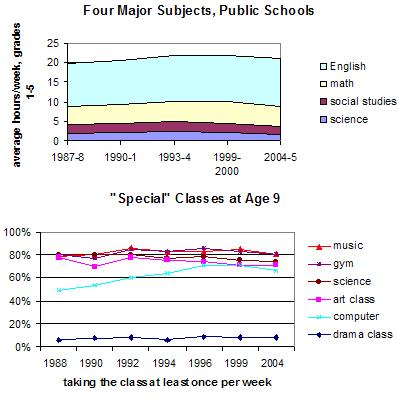
the narrowing of the curriculum

These two graphs indicate that the elementary school curriculum in the US has narrowed somewhat (not dramatically) in recent years. The first graph shows hours devoted to four major subjects throughout grades 1-5; the second tracks the percentage of kids who experience various “special” classes such as art and music. We see an increase in all the academic subjects and some of the “specials” in the 1980s and 1990s, as Americans became concerned about slackness in the whole education system. This was followed by a narrowing of the curriculum as the available time went into reading and math and away from social studies and arts after 1992-4.

Although these trends are not dramatic, I think they deserve public discussion. The cause is more than the No Child Left Behind Act, because the narrowing trend began before NCLB was enacted and is evident in private schools as well as public schools. I associate the narrowing with a whole set of decisions made by local, state, and federal authorities, teachers, schools of education, textbook publishers, and families.

Here are four perspectives that these stakeholders ought to consider and discuss.

1. Back to basics. Reading and math are fundamental. Performance in these subjects is inadequate for the whole population and very unequal. We need to focus our attention on these subjects until all kids can read, write, and calculate. The trends shown above are desirable.

2. The liberal arts. Education today is too instrumental. It’s all about outcomes, especially economic outcomes. It overlooks the intrinsic value of subjects like history, fine arts, natural sciences, foreign languages, and current events. Although such topics can be taught under the heading of “reading,” in fact reading instruction emphasizes skills, not content. Thus the trends shown above indicate a decline in the liberal arts.

3. Cultural literacy. The only way to be literate is to have a base of facts, concepts, and vocabulary. We obtain that base best by studying history, natural science, social science, and foreign cultures. The trends shown above mean that we are failing to emphasize cultural literacy and that is why reading scores are flat despite increased time devoted to reading/language arts.

4. Civic mission. The purpose of schools is not (only) to prepare workers, but also to create an active and egalitarian democracy. That mission requires widespread literacy and numeracy. But it also requires specific knowledge of history, government, social issues, and current events. Such knowledge also correlates empirically with using and enjoying the arts. We are losing those elements of the curriculum.

exit poll predictions

Early on Super Tuesday evening, I guiltily visited the Drudge Report to see the leaked exit poll results, which showed Senator Obama with a big lead in California. Of course, that lead evaporated. Why were the exit polls wrong? In short, because they are not designed to predict the outcomes of elections.

To give a more detailed answer: Commercial and academic pollsters never really try to draw a random sample of Americans from which they expect to be able to derive results directly. Instead, they always construct a sample using a source other than the poll itself to guide them. Most often, they try to fill quotas of interviewees from various categories (e.g., race, region, and gender). Even after they have done their best to fill their quotas using quasi-random methods, they almost always “weight” their data to reflect the demographic breakdown of the population, according to the US Census. For instance, if only seven percent of the sample is age 18-25, when the Census finds that 14 percent of adults are in that age range, then each interviewee of age 18-25 counts for two. (Doubling the weight of some respondents is not uncommon.)

In the case of exit polls, the results are not “weighted” to match Census demographics, because exit polls are intended to describe voters, not residents. Instead, results are weighted to reflect the actual election results, as reported by officials. Thus, if 51 percent of voters cast ballots for Senator Clinton, but 55 percent of people who were interviewed in the exit poll said that they preferred Senator Obama, then each Obama supporter in the poll counts for more than one in the results.

I’m sure that the early results leaked to Drudge were unweighted, because the ballots had not yet been counted. Once they were weighted, they showed a Clinton victory in California, because that’s what election officials reported. This is also why exit polls showed Bush behind in Ohio in 2004, yet he won the election.

This is a legitimate method, because any poll is designed to address only some questions, not all questions. An exit poll cannot predict who will win, but it can estimate (with various sources of error) what kinds of people voted for each candidate. That’s what it’s for.

Some of us are overly credulous about surveys. Others, having realized that surveys are imperfect, discount them all. I recommend carefully considering what questions any given poll can answer, and using it only for those purposes. (Remind me to stay off Drudge on November fourth.)

keeping on top of those young voters

We were up most of the night crunching numbers on young voters in Super Tuesday. They turned out strongly, as predicted, and we’re putting all the latest information on our homepage as we produce it. We’ve been getting lots and lots of press attention throughout the primary season, which is gratifying and a useful opportunity to get people thinking about young Americans as active citizens. The most fun media hit is my colleague Karlo Barrios Marcelo talking about young voters in a Manhattan bar–as seen on CBS news.