Author Archives: Peter Levine

Dewey’s lost chance

(Dayton, OH) On my way to a meeting with two of its authors (and others), I read Dewey’s Dream: Universities and Democracies in an Age of Education Reform (Temple, 2007), by Lee Benson, Ira Harkavy, and John Puckett. It’s a manifesto for reform, which I would like to write about on another occasion. It also tells a story about the great progressive thinker/activist John Dewey, as a kind of “near-miss” (my phrase, not the authors’). In their view, Dewey almost opened a path to deep democratic renewal but made fatal errors. This is the outline:

1888 or earlier: John Dewey, a philosophy professor, decides that philosophical problems can only be addressed experientially and collaboratively. He begins to define “democracy” as a culture and a set of institutions optimally designed for learning. Achieving real democracy (in this sense) requires reform.

1888-92: Thinking strategically about reform, Dewey identifies the news media as the best lever of change. He tries to create a democratic newspaper, Thought News, to achieve “socialism of the intelligence and the spirit.” It is a complete practical failure. (Although it fails, this experiment foreshadows modern uses of innovative media for democratic reform.)

1894: Dewey comes to Chicago and, because of agendas within the University, he is recruited to study education. He decides that schools, not communications media, provide the best levers for democratic change. He creates the Chicago Laboratory School. Its curriculum is experiential and collaborative but completely artificial and driven by Dewey, not by the community. It is a flawed conception, although it could have evolved in better directions.

By 1902, Dewey has spent considerable time at Hull-House, Jane Addams’ great community-based institution for learning, culture, and reform. Having learned from this example, Dewey writes the “School as Social Center,” a manifesto for public schools as hubs of learning deeply embedded in, and owned by, communities. The Lab School could have turned into such an institution, but …

1904: Dewey leaves Chicago for New York where he retreats from full engagement. He focuses on reforming philosophy and deprecates schools as venues for learning and reform. He becomes interested again in the news media but has very vague ideas about it.

ca. 1912-ca. 1939: American schools are deeply influenced by Dewey, but his ideals are often watered down and distorted. Experiential learning becomes a means of accommodating kids to existing social institutions, not a spur to social reform. But there are a few excellent examples, such as the rural schools founded by Dewey’s student Elsie Clapp.

1939: Dewey praises Clapp’s schools but claims that they only work because they are located in rural communities that still embody preindustrial values. He has abandoned the idea that community schools might transform mainstream American society.
the word “populism”

A European reporter asked me today why there is so much alarm about “populist” politicians in Europe–such as Jean Marie Le Pen in France and the late Pim Fortuyn in Netherlands–whereas American politicians with similar views seem to be considered perfectly mainstream. He could have added Hugo Chavez of Venezuela, or even Mahmoud Ahmadinejad of Iran, as examples of leaders who are called “populists” and who alarm Americans.

Fortuyn was a libertarian who seemed hostile to immigrants because they were too conservative about religion and sexuality. Ahmadinejad is on precisely the opposite side of those issues. Le Pen is a hyper-nationalist who is often described as racist. Chavez is also nationalistic but his political base is people of color. These people have only one thing in common: they hold views that highly educated people consider bad and dangerously “popular.” In turn, these diverse foreign populists have various views in common with American politicians as disparate as Dick Armey, Ron Paul, and John Edwards.

The problem, it seems to me, is terminological. In many countries, “populist” is an epithet. It’s OK to be popular, but to be a “populist” means becoming popular by adopting positions that one shouldn’t. Thus it’s populist to hand out goodies derived from oil sales (bad economics), and it’s populist to criticize immigrants (bad values). In Europe and Latin America, you don’t generally say that you’re a populist; you reserve that term for your opponents.

In America, however, candidates proudly call themselves “populists.” The term recalls a controversial but certainly respectable American political tradition going back to the 1890s, if not before. The People’s Party and the Populists took various economic positions, e.g., against tariffs. Whether or not those positions were sensible at the time, they are now obsolete. But the original Populists also emphasized procedural reforms, such as the direct election of Senators. They pioneered forms of politics, voluntary service, and institutions that are still highly valuable. And they embodied a culture of populism which was respectful of local and vernacular traditions, unpretentious, but also dedicated to education and creativity.

Incidentally, the discussion page attached to the wikipedia entry in “populism” is a great introduction to the debate.

we’re moving to Tufts!

During the summer of 2008, CIRCLE will move to Tufts University, becoming part of the Jonathan M. Tisch College of Citizenship and Public Service. My family and I will be moving to the Boston area as well. CIRCLE will leave a satellite office in the DC area, but our home will be Tufts. Working with colleagues there and partners at other institutions, CIRCLE will help to build an innovative, ambitious, and rigorous research program that will influence scholarship and practice and thereby help to renew democracy. I have written more about our agenda here (pdf).

This decision was basically an institutional one. If we had a formal board, they would have voted (I am confident) in favor of a move to Tufts. The University of Maryland is a great land-grant state institution. But Tufts, because of its resources, its people, and its tremendous institutional commitment to civic engagement, will give CIRCLE better opportunities to grow and affect the world.

But even if the choice was pretty obvious for CIRCLE, it was a difficult one for my family and for me, personally. I’ve had a terrific time and learned almost everything I know at the University of Maryland since 1993. I had to think seriously about my own identity and trajectory in order to decide which institution to commit to. At Maryland, I wear several hats, including a research scholar in the Institute for Philosophy & Public Policy, which applies philosophical ideas to a range of public issues. That work matters to me; but faced with a choice, I’ve decided it’s not my identity. I would like to say that I’m a scholar with normative concerns who interacts daily with the practical movement to enhance the quality and breadth of civic participation in America.

Already during the summer after my sophomore year in college, I went to the Kettering Foundation in Dayton (of which I am now a Trustee) to study the National Issues Forums. I must have won that internship based on an application essay that indicated some interest in public deliberation. I then became president of the Yale student government on a platform of increasing the quality and quantity of student engagement in New Haven and Yale. Although it wasn’t my idea, I’m proudest of one successful and lasting policy change that we achieved in that era: a scholarship program for students who conduct summer internships and report their results to local alumni clubs.

I was a philosophy major and received a doctorate in Philosophy from Oxford, but I might not have followed that route if I hadn’t received a Rhodes Scholarship. Winning the Rhodes was, of course, mostly a matter of luck; but my application was all about civic engagement. My first job after graduate school was with Common Cause, the citizens’ lobby. On the strength of that practical experience plus my doctorate, the Institute for Philosophy & Public Policy decided to hire me. And the Institute turned out to be a fabulous platform for conducting research and experimenting with practice in civic engagement. It was the base of the National Commission on Civic Renewal, the National Alliance for Civic Engagement, the Center for Information & Research on Civic Learning & Engagement (CIRCLE), the Prince George’s Information Commons, and numerous other projects. Only because of the institutional and personal resources available to me at Maryland have I been able to find a place in strategic national discussions about civic renewal.

Tufts is committed to precisely this role of generating rigorous and independent scholarship on civic engagement, in dialog with practice and political reform. It might be possible to sustain that work at Maryland, but I believe the odds are better at Tufts that we can expand the seriousness, originality, and rigor of our scholarship and its impact on society.

chamber music

Last Saturday in Syracuse, my Mom and I heard the Rossetti String Quartet play works by Mozart, Dvorak, and Debussey. Such events always provoke nostalgia for me, because chamber music used to play a very important role in my life. In my young adult years in New Haven, Oxford, and Washington, I used to attend concerts at least once a week. I usually went by myself. In childhood, however, I usually attended with my father, who died just weeks ago. He and I often had tickets to the very same concert series, the Syracuse Friends of Chamber Music. In London, we went to many venues, but I especially remember the rather drab hall of the Ethical Culture Society, in which we heard fine performances. And other locations occur to me as stray thoughts–for instance, a basement in Lucca, Italy, where we once heard the Chilingarian Quartet. To tell the truth (at last), I really went along because I liked Dad’s attention on the trips to and from the concert halls. I used to count the minutes until each recital ended; but a habit formed.

I had other reasons to be nostalgic last Saturday. The Syracuse Friends of Chamber Music has moved from the University to a public middle school. It’s not a school that I attended, but it’s part of the same district, and the students’ art and official warning notices on the walls were timelessly familiar. The concert program contained a memorial notice for my own music teacher, who recently died. I recognized many subscribers to the notice; some were parents of my childhood friends. And I knew members of the audience. They were almost uniformly white-haired. The median age must have been 75. These were the same people, indeed, who belonged to the Friends of Chamber Music 35 years ago. They were much the same kind of people who filled Wigmore Hall or Alice Tulley Hall in 1970 and who still predominate at the Phillips Collection or the Library of Congress recitals in Washington.

When we consider why the audience for chamber music has aged and shrunk, it’s tempting to revive the usual explanations: inadequate musical education, limited funds, the kids today. But I suspect a deeper reason, which makes me even more nostalgic or elegiac. If the heart of the chamber music tradition is the string quartet, the piano sonata, the art song, and the trio, then it really lived from about 1750 to 1950. When the audience at last Saturday’s concert was young, Shostakovich and Bartok were still writing chamber works in that tradition. The latest works of that era commented on the classic ones in the repertoire. To be sure, there are still composers today, and they still produce quartets and sonatas. But as far as I know, their style is abruptly different from that of the nineteenth-century masters. They are too hard for almost anyone to perform, and rather difficult to enjoy. They have an audience, but it is small and highly sophisticated. Meanwhile, the tradition of Mozart and Brahms is no longer alive. It is an antiquarian or historical interest. I doubt it will ever die off completely; in the age of Amazon.com, even the most obscure tastes can find markets. But I don’t think it will fully revive unless contemporary music itself reconnects with the classical background–which may not be a natural or even a desirable development.

an opening for the news media

David Carr, a financial reporter for the New York Times, argues that the rising youth turnout rate offers the news media an opportunity to expand their audience among young people. He quotes me, saying, “I think that there is a clear message in here for the media: these campaigns have made very direct and serious pitches to young people and they have responded. … I think it demonstrates that if you approach them in a specific way about things they care about, they will engage.”

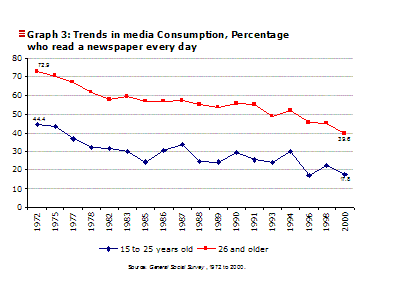
This is certainly an important issue, because using the media (especially a daily newspaper) correlates powerfully with voting and all forms of civic participation, including membership in groups. For young people, news consumption has fallen:

This graph provides an incomplete picture. It doesn’t continue until 2004-7, when you would see some increase in newspaper readership. And it omits other news sources, such as the Internet. But notice that the decline was long, slow, and steady and started well before the Internet achieved mass scale.

I serve as a trustee of the Newspaper Association Foundation and do other work in this field because I believe that the news media (as well as schools and other institutions) need to invest more in building young people’s interest in the news. They are also going to have to rebuild trust, because American youth are more cynical–or sophisticated–about bias and spin in the press than they used to be. The graph below shows trends in trust; our qualitative research finds that young people are especially sensitive to perceived bias and manipulation.