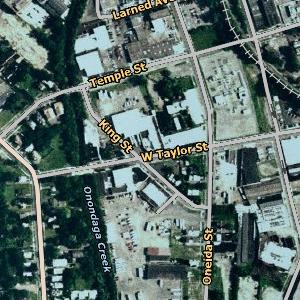
This is part of a largely abandoned section of my home town of Syracuse, NY. It’s very close to downtown and there are some lovely Victorian houses in the neighborhood, mostly boarded up today. A lot of it consists of empty parking lots where once there were factories. I’m surprised that this aerial shot makes it look so green. Most of the green areas must be overgrown but abandoned lots.
Imagine if a government or private donor had the resources to found a new college or university. Such an institution could be designed to create a vibrant new urban neighborhood in a place like this–enriched by students and faculty but not reserved for them alone. To create such a community, planners should harness and direct market energies, and thereby magnify the impact of their investment.
Here’s one way to do this: Obtain most or all of the property, perhaps with some use of eminent domain. Select some non-contiguous blocks in which to build campus buildings. Each block could be designed by a different architect in order to promote variety. At the same time, each block would share some common features. They would all provide a mix of student residences, some apartments for faculty and staff, spaces for eating and studying, and classrooms. I like to imagine all these blocks being built around central courts, and each one might have a tower to create a dramatic skyline.
Then the remaining blocks could be sold or leased to developers. The college or university could use its market leverage to select proposals that contributed variety and quality of design. It could even impose unusual zoning rules, such as requiring developers to build a public inner courtyard in each block. If every courtyard opened to the street in the middle of every block, pedestrians could cross the neighborhood from court to court while traffic passed on the streets.
I’d keep the traditional street plan and retain any historic buildings and major trees. If new streets had to be laid out, I would make them narrow in order to concentrate foot traffic, slow cars, and generate a feeling of energy.
I suppose there are two basic models for universities, with various hybrids and exceptions. One is a park-like campus with the buildings set on lawns and connected by paths or private roads. The other is an urban neighborhood with academic buildings and student residences scattered throughout–the standard European model, which we also see at Boston University, the New School, and some other American institutions. I do not prefer the European model overall; both can be nice. I do think that integrating a new university into an urban neighborhood would be a powerful way to spur economic development and turn abandoned property into valuable real estate.
Several film crews are going around interviewing people about citizenship or civic engagement. Last week, I was filmed for Song of a Citizen, which is still in production. The following clip is from iCitizen Forum, which is produced by Colonial Williamsburg.
My 8-year-old likes it but says that people will be surprised. When they hear the intro, she says, “they will expect an old guy with glasses.”
Senator Obama said in a major speech, “race is an issue that I believe this nation cannot afford to ignore right now.” The New York Times columnist Bill Kristol presumed that this comment would lead to a national discussion similar to the one that Bill Clinton formally launched in 1997, complete with op-eds, academic panels, and blue-ribbon commissions. Kristol hated the idea. “With respect to having a national conversation on race, my recommendation is: Let’s not, and say we did.”
I wouldn’t be nearly as snarky as Kristol was about that idea. However, I find it interesting that two of our most experienced and thoughtful organizers of public discussions have separately argued against having a formal dialogue on the topic of “race.”
Rich Harwood wrote, “I do not believe a so-called ‘national conversation’ on race is the way to go, if that means a repeat of former President Clinton’s effort on this matter. Remember the national commission he appointed, which soon became embroiled in endless issues about its focus? That initiative had all the negative trappings of a high-falutin’ blue-ribbon panel: formal hearings with far more posturing than conversation. After a much ballyhooed launch, the commission landed with a thud.”
Rich offers six good pieces of advice regarding interracial dialogues, including this one: “It is important to actually do something together (the size and scope of the action does not matter as much as the action itself), because conversation alone cannot create the bonds of trust and relationships that we need. Deeper connections will emerge only by rubbing shoulders and finding solutions together to common challenges, demonstrating to ourselves and others that progress is possible.”
Martha McCoy, the executive director of Everyday Democracy, has organized many Study Circles in racially divided communities. She provides a great post about how to make those conversations work. Like Harwood (but unlike Kristol), she thinks that we need to talk about racial tensions and about disparities in social advantages by race. But we need to talk in contexts where people can raise conflicts of interest and values, work through their differences, and accomplish something together. In other words, the issue cannot be reduced to our attitudes about race (why we “pre-judge and fear one another”), but must encompass the ways our communities and institutions are structured. In Study Circles, participants have patiently and carefully addressed gaps and disparities in ways that have led to real change.
So we need local conversations with racial differences very much on the table. We also need national conversations or deliberations about concrete policy options in various domains. It would be great, for example, for Congress to fund national public discussions about climate change and agree to hold hearings on the report that citizens wrote deliberatively.
But I’m not at all convinced that a formal, national discussion of “race” would be focused enough to produce tangible change. If it led nowhere, it would be worse than nothing at all.
Diana Hess is a professor of education at the University of Wisconsin-Madison and the leading expert on all the complex issues that arise when controversial issues are discussed in classrooms. I asked her to contribute an essay for this blog about a fascinating, moving, but ethically troubling video recently shot in a Bronx high school. She writes:
Last week I received an e-mail from Michelle Obama urging me to view a video of high school students in Jackson Shafer’s class at the Bronx High School for Performing Arts and Stagecraft. I watched it immediately because I am interested in hearing what high school students have to say about the campaign and the candidates–and I was so fascinated that I then watched it again. I forwarded it to some colleagues in civic education with this message: “First, what is it about Obama that these kids find so inspiring–why is he able to tap into this hopefulness when others are not? Second, what would it be like to be a Clinton or McCain supporter in this classroom–is this teacher just wisely making use of a teachable moment, or is he sending the message that the election is a question for which there is a right answer? Third, how much fun it would be to be teaching these kids!”
The next day I read a number of newspaper articles about the controversy that the video sparked. It seems that there is a New York City Board of Education policy that prohibits using students for partisan or promotional purposes. Because the video was on the official campaign website it gave the impression that the students (and perhaps the teacher and even the school) were officially supporting Senator Obama’s candidacy. Moreover, in the same message from Michelle Obama, there was a request for donations, which made it appear that the students were being used to raise money, a fact that Mr. Shafer reported not knowing about in advance. There is talk of putting an official letter of reprimand in the principal’s personnel file. I find it astonishing that the Obama campaign would send a staff member into a public high school to shoot video of minors without obtaining required permission (which, it seems clear, would have been impossible to obtain given the policy). That being said, the video does provide an interesting snapshot of how some young people are responding to Senator Obama’s campaign, and also raises hard questions about how a teacher can tap into students’ enthusiasm for a political candidate without creating an environment that compromises democratic principles.
Although newspaper articles about the video report that Mr. Shafer is an Obama supporter, the video does not show him saying anything explicit about his own political preference. He does show his students the video of the now famous speech about race relations in the US, and the students develop and deliver personal “Yes We Can” speeches during class time, speeches that I found incredibly interesting, moving, and hopeful. One of the students reported talking with Mr. Shafer before school started on days following a primary about how Obama had fared.
It is always dangerous to make judgments about what is happening in a classroom without having a more complete picture–we do not know whether the students came up with the idea to create “Yes We Can” speeches or whether that was an assignment that Mr. Shafer created. And we do not know if Mr. Shafer has provided opportunities for students who do not support Senator Obama’s candidacy to voice their opinions. We do not even know what subject this class focuses on–is it social studies? English? But let’s imagine for the sake of argument that the 13 minute video is representative of what is happening in the class writ large. That being the case, what judgments could we make about what is going on here?
First, Mr. Shafer seems like an effective and committed teacher who is willing to ask his students to discuss the very issues of race and how it impacts their lives that we know many teachers shy away from. One student reported that after talking about racism in the class, she began chastising her friends for using racial epithets in conversation–and it seemed to be working. Her friends now say “dude” instead of using epithets. While I have heard from a number of high school teachers that this primary has sparked a level of engagement from the students that they have not seen in past presidential primary election seasons, the students in Mr. Shafer’s class seem exceptionally engaged generally–and remarkably engaged in the elections specifically. The primary is causing them to pay attention to the news. As one student commented, “I never knew what channel CNN was, now I know all the channels.”
Second, the students who speak in the video seem to assume that their opinions about Senator Obama are shared by all of their classmates. As an Obama supporter myself, the partisan part of me was happy to witness how his campaign is touching these young people. But as a teacher, I am of two minds about whether what is happening in this classroom should be lauded or criticized. Providing the students an opportunity to talk about race and how it impacts their lives is clearly important and rare. If Mr. Shafer is using Senator Obama’s campaign as a lever to promote these conversations, then it may simply be the case of a teacher knowing his students well enough that he can tap into their interests to provoke important learning.
On the other hand, I find it hard to believe that all the students in the class are Obama supporters. Keep in mind that Senator Clinton won the New York primary, and even though she lost the youth vote overall, there were still substantial numbers of young people who supported her then and most likely still do now. It is also likely that some students in the school support Senator McCain, or don’t know which candidate they support yet. And even if all the students in the class support Senator Obama, do we really want public high school classrooms to turn into de facto campaign events? I think not– because the presidential campaign is actually one of many mega controversial issues–and like other such issues, our job as teachers is to promote the consideration of multiple and competing perspectives.
It is not always clear the best way to accomplish this goal. In some instances, teachers may have to give more weight to a particular perspective to counterbalance the majority in order to ensure that controversial issues do not turn into questions for which students think there is only one answer. And teachers need to be careful not to throw out the baby with the bathwater–which could happen if students are not allowed to voice their genuine and authentic perspectives on issues in the interest of “balance.”
It is hard to tell from this video whether Mr. Shafer is being sufficiently attentive to the fact that the campaign should be treated as a controversial issue. But if attention is not being afforded the other candidates, and if Senator Obama is put forward as an icon instead of a candidate, then not only has a line been crossed, but an opportunity has been lost. For Mr. Shafer appears to be a strong teacher who has the respect of his students, and the students are amazing–sharp, engaged, spirited, and fun. The class has loads of diversity, including racial, ethnic, linguistic, and gender. And my guess is that there is lots of ideological diversity in the class as well. Thus, we have all the ingredients for exceptionally high quality democratic education: a strong teacher, engaged students, and diversity. Engaging students in deliberation about highly controversial issues, like the presidential campaign, in such an environment is an opportunity that is too powerful to waste.
‘Tis the season for dissertation defenses, apparently, and I’m participating in two over the next 48 hours. One concerns abortion escorts, those people who voluntarily walk women into abortion clinics that are surrounded by anti-abortion protesters. The other is a history of congressional pages, those boys (and now also girls) who work for the House and Senate while they attend a special school. The page program is formal and rather prestigious. The escorts are at the opposite extreme: they do not even have an organization, let alone an official place inside the US Capitol. Yet both groups represent particularly intense and demanding forms of “citizenship.”