Author Archives: Peter Levine

the payoff of “diversity”

I’m at a retreat center in the rural Midwest, with representatives of about 40 other organizations. As part of the retreat, we heard from an excellent provider of diversity training. He noted that most such trainings are actually counterproductive. They just make people feel defensive and uncomfortable. The session today emphasized the positive effects of having a more racially and ethnically diverse workforce–as a path to better products, lower turnover, and more satisfied clients.

I agree that there’s much to be gained by demonstrating the economic advantages of diversity to businesses (and the educational advantages of diversity to universities). At the very least, it reduces their sense that diversity would hurt their bottom line. But we do need to keep our eyes on the issue of “distributional justice.” We must ask who gets valuable opportunities and–specifically–whether African Americans, Latinos, and Native Americans are getting fair shares. It’s an empirical question whether we can achieve distributional justice by emphasizing the benefits of racial and ethnic diversity to organizations. That strategy has the great advantage of being persuasive and appealing to powerful institutions. But it’s possible for firms and universities to buy “diverse” workforces without doing anything to address the disadvantages of being born in lower-income minority communities in the US. So I support arguing that diversity helps the bottom line, but only if that’s fully true and it advances our fundamental moral objective, which is equality of opportunity.
a widening gap

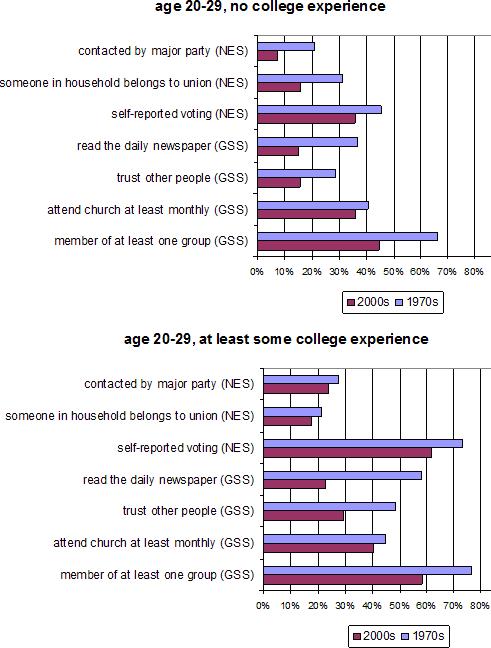
A wide gap has opened between the half of young Americans who attend college and the other half who do not. I am particularly concerned about the gap in political and civic participation. Those who express their views and cast their votes get more attention from government. Voting also correlates with other forms of civic engagement, such as following the news, joining organizations, and volunteering. When young people are not engaged in these ways, society misses their contributions: their ideas, energy, and social networks. And engaging in these ways is good for young people themselves: it provides information, networks, opportunities, motivation, and support. Those who volunteer are substantially better off than those who do not. A dramatic example is the finding that belonging to voluntary associations in Chicago is associated with lower death rates, especially for African American men.*

The following two graphs show the prevalence of civic engagement for young Americans during the 1970s and during the current decade. The first graph shows only young Americans without college experience; the second shows the ones who have attended at least some college.

Comparing the two graphs shows that youth on a college track are far more engaged. Engagement has declined in both groups over time; but proportionally, the change among non-college youth is much greater. While their voting rate has fallen significantly, their rates of union membership, newspaper readership, and contact by major political parties have been cut by more–at least by half. (I include trust in other people because it correlates with membership in groups and social networks.)

*See Kimberly A. Lochner, Ichiro Kawachia, Robert T. Brennan and Stephen L. Bukac, Social capital and neighborhood mortality rates in Chicago, Social Science & Medicine, vol. 56, issue 8 (April 2003), pp. 1797-1805

the effects of Obama’s organization

Senator Obama has 1.5 million donors, countless volunteers, a massive email list, and additional layers of organization, such as his trained “organizing fellows.” What does this mean for the future of politics and government?

Matt Stoller argues that Obama will have tremendous power within the Democratic Party. His supporters are even deliberately trying to de-fund alternative sources of power, such as America Votes.

Marc Ambinder reports that the Obama campaign is going to organize “more than a million donors and volunteers to directly persuade their neighbors through a variety of media” during the campaign, thereby bypassing the news media.

And Steve Teles and I argue that Obama has a chance to pass major legislation, such as health care reform, if he uses his organized base as a grassroots lobbying force after the election. We wrote this when the argument was Obama vs. Clinton. Our idea was that Obama would have a better chance to pass legislation because of his organizing campaign. Now the contrast with Clinton seems moot (to me), but the prospect of massive grassroots lobbying remains interesting. Power over the party, the media, and Congress–that is something to think about.

the power of experimentation

Today’s World Bank’s meeting on community service programs turned out to be mainly a debate about the value of randomized, controlled experiments in evaluation. The Bank wants such evaluations (as does the US Government); many activists and proponents of youth service don’t want to do them. I am also thinking right now about randomized experiments because I will soon play a role in running one in Florida schools.

Experiments don’t work for all purposes; they are not always practical; and they’re not the only legitimate methods.

I did, however, share a positive example of how experiments can be very helpful–in getting out the vote. There were no experiments with voter turnout in the United States for 50 years. That’s surprising because voting is a very simple, measurable act that’s well suited to experimentation. In the mid-1990s, some academics and foundations started pressing the nonpartisan voter turnout groups to use randomized evaluations. The pressure at first seemed unreasonable and even arrogant. It seemed as if the experts wanted randomization for the sake of it.

But now the nonpartisan voting groups are avid experimenters. They are always looking to randomize treatments and investigate the differences in results. When they send out mailings, they design two or more messages and randomize their lists. When they work in a limited number of sites or communities, they choose the sites randomly and reserve others as a control group. They do this even when they are not pressured by funders.

I think there are three major reasons for this “culture of experimentation”:

1. Randomized experimentation is a simple, transparent process. It does not involve elaborate mathematics, which you do need for statistical models. Thus the grassroots groups control their own evaluations. They don’t have to trust outside experts. Experimentation is actually non-technocratic.

2. Random experiments yield useful and counter-intuitive results. For example, going door-to-door is cost-effective even though it costs quite a lot of money per contact. Emails are not cost-effective even though they are cheap. This is good to know.

3. Experimental results can persuade powerful people who are predisposed to be skeptical. The American political parties traditionally assumed that it was a waste of money to mobilize young people. In the 1990s, political consultants often deliberately stripped young people from contact lists to save resources. But the experimental evidence showed that young people would vote if contacted. That led to much more partisan investment in youth turnout. The Obama campaign even has a youth director who comes straight out of the youth voting community in which the experiments were conducted from 1998-2006. Regardless of the experimental data, Obama probably would have campaigned to youth, because he has an appeal with the new generation. Still, it doesn’t seem a complete coincidence that (a) we learn how to mobilize young voters by experimenting, and (b) a candidate captures the Democratic nomination by mobilizing youth.

when is political participation good for the participants?

I’m speaking tomorrow at the World Bank, which has some interest nowadays in the link between civic engagement and youth development. Basically, the idea is that investing in opportunities such as community service will benefit young people around the world, helping them to stay in school, avoid crime and disease, and generally flourish.

We know, indeed, that there are strong positive correlations between service and flourishing for Americans of all ages. Young people who volunteer do better in school; old people are less depressed. To some extent, success may cause volunteering. If you have more money and time, if you’re associated with better institutions, and if you have more confidence and initiative, you are more likely to conduct activities that we call “volunteering” or “service.” For instance, a full-time, white-collar worker may “volunteer” as part of an annual office outing, whereas a homeless person is unlikely to do something that would be called “volunteering” (although he might help his peers).

To an important extent, the reverse is true as well: volunteering contributes to flourishing. We know this from fairly careful studies, including studies of mandatory service (which avoid the problem that volunteers may be self-selected).

But this is the issue I’d like to raise at the World Bank: “volunteering” does not exhaust civic engagement. Citizens who want to change the world for the better may reasonably select other strategies, including voting, protest, building organizations, convening meetings, or even the age-old tactic of the oppressed, non-compliance. I often cite an example from a CIRCLE Working Paper by Michelle Charles. African American youth in Philadelphia are supposed to be cleaning up graffiti under the direction of middle-class adults. They are dragging their feet, presumably because they think this particular activity is pointless. To me, their service is not civic engagement, but their foot-dragging is. It may have the affect of ending the program, which will be positive social change.

These other forms of civic engagement are not correlated with prosperity and health. Protest, for example, is much more common among Latino and immigrant American youth than among White Anglo youth. That doesn’t mean that protest is bad for individual human development. I don’t think we know enough about its developmental effects (notwithstanding some important studies of 1960s activists). But it certainly could be the case that “volunteering” is good for social adjustment, and protest is bad for individual success, but good for society.

In other words, the strategy of encouraging youth to volunteer has a political agenda to it. Not being radical myself, I may be willing to endorse this strategy; but it’s worth arguing about. Certainly, many of the globe’s young people may resist the idea that they should be better accommodated to existing institutions through service.