Author Archives: Peter Levine

why study service-learning?

I’m at Brandeis for a meeting of “emerging scholars” who study service-learning. They are paired with established mentors who advise them, and they enter a network of other new scholars in the field. This is a project (which we are helping to run) that is part of a larger effort to build the field of service-learning. I also participate in the “emerging leaders” part of the effort, which supports younger managers and organizers. Both aspects are funded by the Kellogg Foundation.

This seems an appropriate moment to ask why anyone should study service-learning (the combination of community service with academic study). I would say:

1. Because studying young people who are asked to work on a community problem or issue is a great opportunity to investigate large issues about human development, the reproduction or reform of institutions and cultures, learning, deliberation, racial conflict, and many other issues. In other words, service-learning is an opportunity for social science.

2. Because service-learning is common–present in about half of American high schools–yet the quality is very uneven. Research can identify what aspects of service-learning generate good results in various contexts. Once we know that makes service-learning succeed, we can inform future teachers in their education courses, explain the criteria in program guidelines, and so on.

3. Because there is an opening for new policies that involve service. Senators McCain and Obama both favor service-learning, and there is an effective nonpartisan advocacy campaign for national and community service programs. It is fairly straightforward to design new policies for Americorps. But it’s not so easy to say what a good service-learning policy should be for k-12 schools. Policies cannot automatically create high-quality educational experiences. They always operate through rather crude incentives or rules–for instance, grant opportunities, mandates, course requirements, standards, or state-sponsored exams. We need research about the likely impact of policies before we can tell friendly politicians which policies they should promote.

Note that even a friendly politician must make choices–must decide how much resources to put into service-learning compared to other activities, including other forms of experiential civic education. Responsible advice to policymakers thus depends upon careful and rigorous comparative research. It’s not enough to say that service-learning is good; we have to know whether each marginal dollar is better spent on it or something else.

4. Because a lot of adults are involved in a field called service-learning, and it’s a good group–diverse in goals and ideologies but idealistic and fairly coherent. To use an over-used term, it’s a “community.” Communities can deserve loyalty even if one doesn’t believe that they are objectively better or more important than other communities. I’m not sure that I believe service-learning is a better, or even a more promising, intervention than some others. I am sure that the community that supports it is a good one. According to the great work of Albert O. Hirschman, when one wants to change a group, the two choices are “exit” and “voice.” Exit is the main mechanism in a market, and it is a good one. We use “voice” when we cannot exit a group (e.g., a family or a nation), or when we are loyal. I think the service-learning world merits some loyalty, and that means using our voice to improve it. For those of us who are scholars, the best form of voice is research.
the ethics of liking a fictional character

(Waltham, Mass.) I have mentioned before that Middlemarch is my favorite book. Specifically, I am fond of Dorothea Brooke, its heroine. I like her; I want her to succeed and be happy. Allowing for the fact that she is a fictional character, I care about her.

Such feelings represent moral choices. Caring about someone is less important when that person happens to be fictional, but novels are at least good tests of judgment. Thus I am interested in whether I am right to care about the elder Miss Brooke. It seems to me that George Eliot was also especially fond of her heroine, and one could ask whether that was an ethical stance. Or, to put the question differently, was Eliot right to pull together a set of traits into one fictional person and describe that person in such a way as to make us like her?

The traits that seem especially problematic are Dorothea’s beauty, her high birth, and her youth. She is a young woman from the very highest social stratum in the hierarchical community of Middlemarch, surpassed by no one in rank. She is consistently described as beautiful, not only by other characters, but also by the narrator. In fact, these are the very first lines of Chapter One:

Miss Brooke had that kind of beauty which seems to be thrown into relief by poor dress. Her hand and wrist were so finely formed that she could wear sleeves not less bare of style than those in which the Blessed Virgin appeared to Italian painters; and her profile as well as her stature and bearing seemed to gain the more dignity from her plain garments, which by the side of provincial fashion gave her the impressiveness of a fine quotation from the Bible,–or from one of our elder poets,–in a paragraph of to-day’s newspaper. She was usually spoken of as being remarkably clever, but with the addition that her sister Celia had more common-sense.

This introduction contains no physical detail, in contrast to the portrayals of other characters in the same novel, such as Rosamond and Ladislaw. The simple fact of Dorothea’s beauty is not complicated by the mention of any particular form of beauty that a reader might happen not to like.

We have a tendency, I think, to want beautiful and high-born but lonely young ladies to live happily ever after. When we were young, we heard a lot of stories about princesses. We expect a princess to become happy by uniting with a young and attractive man; and whether that will happen to Dorothea is a suspenseful question in Middlemarch.

If we are prone to admire and like Dorothea because she is beautiful, Eliot complicates matters in three ways. First, she produces a second beautiful young woman in need of a husband, but this one is bad and thoroughly unlikable. (At least, it is very challenging to see things from Rosamond’s perspective, as perhaps we should try to do.) Second, in Mary Garth, Eliot creates a deeply appealing young female character who, we are told, is simply plain. Third, Eliot makes Dorothea not only beautiful, but also “clever” and good.

Evidently, beauty does not guarantee goodness, nor vice-versa; yet several people in Middlemarch think that Dorothea’s appearance and quality of voice manifest or reflect her inner character. This seems to be a kind of pathetic fallacy: people attribute virtues to her face, body, and voice as poets sometimes do to flowers or stars. But of course the characters who admire Dorothea’s appearance as a manifestation of her soul may be right, within the world that Eliot has created in Middlemarch. Or perhaps character and appearance really are linked. Rosamond, for instance, could not be the same kind of person if she were less pretty.

I presume that it is right to like someone for being good, but it is not right to like someone because she is beautiful. One could raise questions about this general principle. Is someone’s goodness really within his or her control? Perhaps we should pity (and care about) people like Rosamond who are not very virtuous. On the other hand, if we can admire beauty in nature and art, why not in human beings? And what about cleverness, which is not a moral quality but is certainly admired?

One interpretation of the novel is that Dorothea does not have a moral right to her inheritance or to her social status. These are arbitrary matters of good fortune, and she is wise to be critical of them. She does, however, according to the novel, deserve a happy marriage to a handsome man because she is both good and beautiful (and also passionate). The end of the novel feels happy to the extent that she gets the marriage she deserves. Does this make any sense as a moral doctrine? Is it an acceptable moral doctrine within a fictional world, but inapplicable to the real world?

Beautiful people tend to find other beautiful people, just as the rich tend to marry the rich and (nowadays) the clever marry the clever. Lucky people have assets in the market for partners. But is this something we should want to see? What if the plain but nice Mary Garth ended up with a broodingly handsome romantic outsider, and Dorothea married a nice young man from the neighborhood? Would that ending be wrong because beauty deserves beauty, or would it only be an aesthetic mistake (or a market failure)?

CIRCLE’s youth primary wrap-up

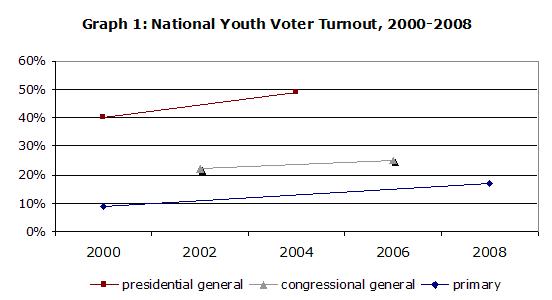
Today we released our analysis of youth turnout in the whole primary season. Youth voting almost doubled, compared to the best comparison year, 2000. That makes the primary the third straight federal election in which there has been a substantial increase.

For ages 18-29, these are the recent trends in national elections:

CIRCLE’s fact sheet and press release are here.

If the increase continues in the general, it will be interesting to see the impact on certain states where youth turnout was relatively low in 2004. Our interactive map allows you to explore these patterns. Especially interesting are Virginia (41% turnout of under-25s in 2008), New Mexico (42% turnout), and Florida (46% turnout). In each of these states, people between the ages of 18 and 25 represent 9% or 10% of the voting age population. For comparison, 69% of Minnesota’s youth voted 2004 (28 percentage-points more than in Virginia). Substantial increases this year in states like Virginia and Florida could shape the Electoral College.

the public and history

Here are two rival stories about the role of American history today:

1. American history used to be told in an elitist fashion. It was all about the intentions and actions of a few powerful individuals, almost all white men. Ordinary people (including ordinary white men) were marginal or invisible. Historical writing failed to give citizens a sense of agency, because all the power and influence seemed to belong to national elites. Then social historians began to democratize the past and bring it closer to students’ and readers’ experience by uncovering the daily world of farmers, soldiers, mothers, slaves, and others, in their specific circumstances. All kinds of people could find themselves in the past.

2. Many Americans are fascinated by great events and leaders. There is a huge audience for biographies, especially of presidents and generals. Millions visit battlefields and the historic homes of leaders; they want to know where Lincoln spoke or Stonewall stood. But historians write about minute details of social life, often using grand abstractions, like race and gender. They push schools and public facilities to emphasize traditionally oppressed people. For example, Chris Mackowski and Kristopher White noted at their talk on Tuesday that the Fredericksburg and Spotsylvania County Battlefield site has a sign about slave cabins even though there are no extant cabins or other remains to be seen there. Mackowski and White argued that this sort of display is alienating. People want to learn about Robert E. Lee, not about social history. Experts are responsible for the dominance of social history, which explains why students don’t major in history and why young people don’t know historical facts. (For instance, most 17-year-old Americans cannot place the Civil War in the period 1850-1900.)

I’m not sure what to think, myself. I will note that young people do study American history (it’s a requirement virtually everywhere), and they still recall a fairly traditional curriculum. We find that the three themes that young Americans remember studying most are: the Constitution and the American political system, “great American heroes and the virtues of the American system of government,” and wars and battles. Only 9 percent of young people recall any emphasis on “racism and other forms of injustice” in their social studies classes. Therefore, I can’t buy the argument that because young people are forced to study depressing facts about social life, they don’t know exciting facts about heroes. But that still leaves a deep question about what we ought to know.

philosophy and the city

I’m a philosopher by training. All my work now involves civic engagement or civic education (broadly defined). And I have always lived in and loved cities. Thus I am the perfect person to appreciate Sharon Meagher’s website (and book) entitled Philosophy and the City. I learned about this project from Meagher herself, when she spoke yesterday at a conference called Beyond the Academy: Engaging Public Life. Meagher has her students investigate, explore, and appreciate Scranton, where they are enrolled as undergraduates. In the process, these young people (mostly from suburbs) think about cities: what they mean; how they are linked to virtues and vices (both in stereotypes and in reality); what defines citizenship of a city, and other great philosophical questions.