This is my first blog from the Jonathan M. Tisch College of Citizenship and Public Service at Tufts University in Medford, MA. Effective today, CIRCLE is part the Tisch College and I am also research director of Tisch. I am deeply absorbed in trying to get my old calendar system to sync with my new calendar, but I encourage you to explore Tisch, which is (I believe) still the only whole college devoted exclusively to civic engagement.
Author Archives: Peter Levine
the Public Education Network (PEN) and its civic index
I believe that communities educate children, not just schools; and it is a false hope that we can achieve dramatically better results by tinkering with the structure of schools: their governance, funding, incentives, and regulations. Most experiments that focus narrowly on schools, from Reading First to privatization in Philadelphia, seem to fail. PEN, the Public Education Network, is a great leader in promoting this idea:
While there is a broad public understanding about the important role that schools play—teaching, learning, curriculum development, assessment, discipline, student development—few individuals in communities understand their civic role, whether they be parents, or adults without children in school, in contributing to quality public education for all students.
Communities provide the social, financial, and political capital that is crucial to school and student success. Citizens vote for elected leaders, pay taxes that fund schools, and also participate in powerful social networks that shape how schools and communities address the educational and developmental needs of young people. There is an inextricable link between high achieving schools and the community actions that support these schools. Without public action, there can be no quality public schools.
With a small assist from CIRCLE, PEN recently unveiled its “Civic Index for Quality Public Education,” which is a survey that any community can conduct, compare its local results to national data, and develop strategies for improving civic engagement.
losing color
Robert Darnton, the great Princeton historian, is no Luddite. He welcomes Google’s Book Search, which provides direct access to scanned versions of books from the New York Public Library, Harvard, Michigan, Stanford, and the Bodleian. However, he lists several reasons not to give up on traditional, bricks-and-mortar libraries or to assume that a digital archive can replace them. I will add another reason, which applies (an any rate) to the current version of Google Book Search. Google uses black-and-white photography to reproduce books that were originally printed in black ink. But all real books have color–especially the old ones, whose paper yellows unevenly. In Google’s photographs, all the books published before 1900 look bleached and considerably less attractive than they really are.
moving day
Pockmarked with nails, the walls echo. Dust clots mark the outlines of cozy furniture. The cat slinks in search of cover. In a long hall where once a toddler learned to run, flinging herself again and again on parents’ knees, stacks of cardboard cubes are marked with one word each: “pots,” “toys,” “coats.” The boxes carry away traces of Thanksgiving meals, birthday parties, imaginary villages, winter walks. A key in the lock, a backward look. Onward.
college and kids
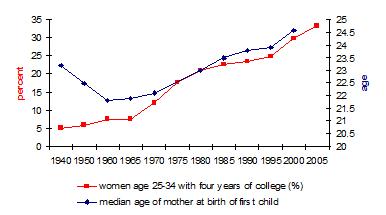
I guess this is a well-known story, but I wanted to document it. Here is the median age that American women have their first child (in dark blue) and the percentage of younger women (age 25-34) who have completed four years of college (in red). From 1945-1965, women bore their first babies at an increasingly early age, and women’s educational attainment did not rise much. This was the era of the Feminine Mystique and “Leave it to Beaver.” Then we see a very substantial rise in educational attainment, and childbearing is delayed. Today, it is common for a woman in her late 20s to have a college degree and children in her future, but none born yet. That combination was really quite rare in 1960.