Author Archives: Peter Levine

broadening philosophy

Moral philosophy (or ethics) forms a diverse and eclectic field, about which few accurate generalizations can be made.* However, I think I detect a very widespread preference for concepts whose significance is always the same–either positive or negative–wherever they appear. In defining moral concepts, philosophers like to identify necessary and sufficient conditions, such that if something can be done, it will always be obligatory, praiseworthy, desirable, permissible, optional, regrettable, shameful, or forbidden to do it. These moral propositions may have to be considered along with other valid propositions that also apply in the same circumstances. For instance, honesty may be obligatory (or at least praiseworthy); yet tact is also desirable. Honesty and tact can conflict. Hardly anyone doubts that we face genuine moral conflicts and dilemmas. Yet the hope is to develop general moral propositions, built of clearly defined concepts, that are always valid, at least all else considered.

But what should we say about complex and ambiguous phenomena that have evolved over biological and historical time and that now shape our lives? I am thinking of concepts like love (recently discussed here), marriage, painting, the novel, lawyers, or voting. We can’t use these words in a deontic logic made up of propositions like “P is necessary.” They are sometimes good and sometimes not. We could try to divide them into subconcepts. For instance, love could be divided into agape, lust, and several other subspecies; painting can be categorized as representational, abstract, religious, etc. Once we have appropriate subconcepts, we can say that they have a particular moral status if (and only if) specified conditions apply.

The urge is to avoid weak modal verbs like “may” and “can” or other qualifiers like “sometimes” and “often.” Love can be wonderful; it can also be a moral snare. Paintings sometimes invoke the sublime; sometimes they don’t. Lawyers have legitimate and helpful roles in some cases and controversies, but not in others. A core philosophical instinct is to get rid of these qualifiers by using tighter definitions. For example, agape (properly defined) might turn out to be always good and never a snare. You always need and have a right to a lawyer when you are arraigned. All paintings by Giorgione or similar to Giorgione’s are sublime. And so on.

My fear is that the pressure to avoid soft generalizations prevents us from saying anything useful about a wide range of social institutions, norms, and psychological states. They don’t split up neatly into subcategories, because they didn’t evolve or develop so neatly. They won’t work in a deontic logic unless we allow ourselves soft modals like “may” and “can.” And yet, outside of philosophy, much of the humanities involves moral evaluations of just such concepts. For example, a great nineteenth-century novel about marriage does not claim that marriage is always good or bad, or always good or bad under specified conditions. The novel evaluates one or two particular marriages and supports qualified conclusions: marriage (in general) can be a happy estate, but it also has dangers. It is wise, when contemplating a marriage, to consider how events may play out for both partners. “Marriage,” of course, means marriage of a specific, culturally-defined type (monogamous, exogamous, heterosexual, voluntary, permanent, patriarchal, and so on). That institution will evolve subtly and may be altered suddenly by changes in laws and norms. The degree to which the implied advice of the novel generalizes is a subtle question which the novel itself may not address.

Much contemporary philosophy has a forensic feel. The goal is to work out definitions and rules that, like good laws, permit the permissible and forbid the evil. I do not doubt the value of forensic thinking–in law. I do doubt that it is adequate for moral thinking. It seems to me that the search for clearly defined and consistent concepts narrows philosophers’ attention to discrete controversial actions (abortion, torture, killing one to save another) and discourages their consideration of complex social institutions. It also directs their energy to metaethics, where one can consider questions about moral propositions, rather than “applied” topics, which seem too messy and contingent.

Continue reading

erasing the people

IMG_0473On our recent trip to Prague and ?eský Krumlov, we took lots of photos of places that are mobbed with tourists. Like everyone else, we would often wait until crowds parted a little to snap our pictures, showing either empty spaces or our own family, surrounded by old buildings. Other visitors sometimes politely stopped to allow us to shoot pictures without them in the frame.

All this bothers me a bit. We’re erasing one another from our images, creating ghost towns out of crowded old cities and depopulating our natural wonders. It might be interesting to make a photo essay out of the tourists, or at least to write about their behavior in relation to the objects they observe. (I did a bit of that once in Madrid.)

the Obama youth appeal as challenge and opportunity

Here are two recent articles suggesting that Barack Obama’s strong appeal to youth may alienate older voters:

  • Alec MacGillis in the Washington Post (8/12): “When Gene Rutherford, 65, tries to make sense of the meteoric rise of Barack Obama, and the rampant enthusiasm for him among younger Americans, he thinks of the local mall, where as director of operations he often deals with teenagers. ‘Kids today have been given everything they want, and don’t have to work for it. They have no respect for authority,’ said Rutherford, standing at the bar at the Elks lodge here. ‘They’ll make remarks right to the face of the [mall] cops. I get to the point where I want to do something,” he said, cocking a fist as if to threaten a punch. ‘But the police say we can’t, that we just have to stand there.’ It makes him worry for the country.”
  • Peter Feld in Advertising Age: “Mr. Obama’s brand management, unprecedented in presidential politics, shows pitch-perfect understanding of the keys to appealing to the youngest voters. …His success, it seems, is a result of both product and the branding behind it. The qualities he projects — a cool, smooth aura, the communal values of hope and unity, his teeming crowds and his campaign’s seamless graphics — are the essence of appealing to millennials. [But] Mr. Obama’s packaging might discomfit older generations.”

These articles ring true to me. They explain and–to some extent–excuse the McCain ads that link Obama to Britney and Paris. The ads that were used against Rep. Harold Ford Jr. in 2006 were racist; they stoked white sexual fears by suggesting that a black candidate might have sex with a young white woman. But the McCain ads in this cycle don’t sexually link Obama to Britney and Paris; they equate him with those two celebrities. The charge is that he is merely “cool”–attractive, popular, and good on TV–and that he doesn’t deserve to be a leader or a role-model. McCain is trying to turn Obama’s popularity with hip young people into a liability by invoking legitimate discomfort with our media-obsessed, superficial, pop culture.

But the ads are fundamentally unfair. Obama himself is a very serious guy–not a superficial celeb but an intellectual and a social activist. Moreover, his core young supporters are not superficial and media-obsessed. Something like 15 percent of young Americans voted for him in the primary. (25 percent voted, but some chose another candidate.) We know that they were disproportionately college students, and I suspect they were disproportionately “civic”–experienced with volunteering, political discussions, and membership in voluntary groups.

That means that they were not the young folks who bother Mr. Rutherford by hanging around malls in Lancaster County (PA) and hassling security guards. In fact, young people who are alienated from adult life and hang around malls have little voice in politics and government. They hardly voted in the primaries, and no one is talking about their issues.

The core Obama supporters are unlikely to think much of Paris and Britney. Their tastes in music and entertainment are probably much more socially-conscious, multicultural, and sophisticated. Nor are they disrespectful of authority and tradition. One of the hallmarks of young social activists today is politeness. They are close to their parents and deferential (sometimes to a fault) around people like professors and business leaders.

An opportunity arises for Obama because he offers answers to the problems that bother Mr. Rutherford and other older Americans. First, Obama is not a youth phenomenon. He is an intergenerational figure: a parent and an experienced college teacher and community organizer with roots in churches and service programs. Second, the kinds of programs he most passionately supports are the ones that connect youth to older people. They are antidotes to the problem of teenagers hanging round malls. And third, his moral and spiritual beliefs allow him to criticize the superficial, commercial, and sexist aspects of youth culture with authenticity. (By the way, most of the young people who support him will share that critique.)

communism, in context

Walking along a street in Prague, I overheard an American say loudly, “They all eat lunch at 1 o’clock here. It’s because of Communism–the inefficiency still exists.” I hadn’t realized that getting lunch at 1 made you a commie, but now I’m sure to eat mine before 12:30 pm.

Seriously … visiting a recently communist country makes you think about the legacies of that system. And it was an awful regime. “The people” never owned the means of production; a few thugs controlled all the valuable stuff and used it for their own benefit. The story of Milada Horáková, a feminist, socialist, and democrat who was judicially murdered by the regime, serves as a fitting summary.

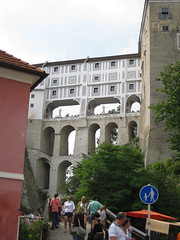
IMG_0365But it’s not as if communism was the first authoritarian system in the country. The Nazi occupation lasted from 1939-1945. The Austrian Empire ruled from to 1620 to 1918. Even older and more consistent was feudalism, a system under which serfs were bound to the land and required to give their surplus produce to landlords who were also their political and judicial rulers. Serfdom was abolished in 1781 but its effects lingered. If one wants to feel a glimmer of sympathy for communism, it’s worth thinking about the serfs who paid for the State Castle of ?eský Krumlov and so many other “stately homes.” My photo shows only the corridor from the residential quarters to the baroque theater, built over an enormous ravine for the convenience of the resident Eggenberg family. They and their successors owned all this property not because of their creativity and industry, but because their distant ancestors had wielded big swords.

Of course, the solution to feudalism was not communism, but democratic and legal land reform, which the inter-war Czechoslovak government undertook. At that point, the State Castle became a public asset, and a charming one. But it is worth noting that communists were not the first to monopolize power in their own interests.

Charles Franklin on the youth vote

For readers who follow this blog out of an interest in youth voting, a must-read post is Charles Franklin’s at Pollster.com. His graphs are illuminating and detailed. He acknowledges that mobilizing young voters in 2004 made a significant difference to their turnout and kept Kerry in the game. But he argues that young voters always vote at such low rates that it is better to campaign to the elderly. Besides, older voters–contrary to their reputation for being set in the ways–actually swing more from Democrats to Republicans, which makes them prime targets for outreach.

To be sure, older voters are prime targets. No one would advise a campaign otherwise. The question is where an extra dollar of campaign money makes the most difference. I would not be surprised if the marginal impact is actually greater among the young. Youth voting rose proportionally in 2004 and made a difference in the campaign. That happened despite very modest levels of investment in youth voting by the Democratic Party and nominee. It’s quite plausible that each dollar spent on youth paid off quite nicely. (See our estimates of cost-effectiveness here; although unfortunately we cannot compare impact by age group.)