Author Archives: Peter Levine

an unprecedented age gap

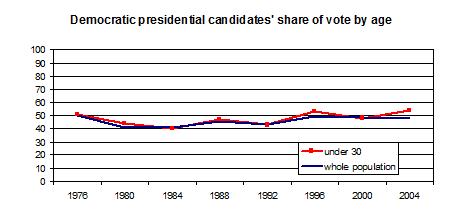
In elections since 1976,* young people (ages 18-29) have voted slightly more Democratic than the population as a whole. The average difference between the preference of under-30s and the national popular vote has been a mere 1.8 points. In 1984 and 2000,** the Democratic presidential candidate performed just slightly worse among young people than in the whole population.

But a recent Gallup poll of the 2008 campaign found Obama leading McCain by 62% to 34% among youth. In the same survey, Obama did not surpass 50% in any of the older age groups. If these numbers hold up, there will be an unprecedented age gap in voter preferences. No wonder there is such enormous interest in the youth vote story. For us at CIRCLE, it’s always about democratic participation and youth voice. But this year, it’s also about who wins the White House.

*I believe the 1972 exit poll did not disclose age. Before 1972, the voting age was 21.

**In 2000, Gore beat Bush among young voters, 48%-46%, but Nader drew 5% of young people.

media bias and election outcomes

The conservative world is abuzz with the idea that liberal news media are either hurting McCain or making his polling results look worse than his real support in the public. I know plenty of liberals who believe that the rise of Rush Limbaugh and Fox News accounts for conservative electoral victories after 1992. These two claims don’t cancel out; one or both could be true. But a full statistical model of election outcomes would have to factor in at least:

a. The fit between candidates’ positions and public opinion

b. The candidates as communicators/symbols

c. Strategic and tactical political decisions by campaigns

d. Grassroots activity by citizens

e. Campaign finance

f. Changes in the real economic and social circumstances of voters before the election

g. The real performance of the incumbent administration

h. Media bias

I can imagine that (h) would account for some of the variance in election results. But I don’t think it can explain too much, because there is a lot of evidence about the importance of (f). Specifically, changes in inflation-adjusted, disposable household income before an election remarkably predict whether the “in” or “out” party wins. And people know their own income; they don’t need the media to tell them.

We should wish that (a), (d), and (g) would explain most of the variance in election results. Those are the democratic inputs. Political reforms should maximize the importance of these factors. (H) is unfortunate, but I doubt it’s very important once the other factors are considered.

a new progressive era?

A reporter asked me yesterday whether a hypothetical Obama victory might mark the beginning of a “new progressive era” (which happens to be the title of my 2000 book). It occurs to me that, yes, we might see a new progressive era, as long as we understand that phrase in a certain way.

In my view, the original Progressive Era was not defined by one agenda or set of policies, such as the launch of new federal regulatory agencies. It was defined by some very vigorous debates among people who called themselves progressives but had quite different orientations. They all agreed about some problems, such as the human suffering and environmental degradation that accompanied industrialization. But they disagreed profoundly about such essential matters as the role of expertise versus citizen participation; the conflict between centralized and local power; the value of cultural pluralism as opposed to some kind of unified natural culture; the organization and methods of the press; and the proper role of “special interests” (including unions, parties, and ethic associations) versus nonpartisan “public interest” associations such as the League of Women Voters. People who called themselves “progressives” could actually take diametrically opposite positions on these issues.

So a New Progressive Era would mean a reopening of such debates among people who were generally dissatisfied with the performance of the market but who disagreed about other important matters. Like their Progressive forebears, they would have to invent or develop new institutions and modes of social organization appropriate to a new economy. In general, these new institutions should be flatter and more open than the bureaucracies of the mid-20th century.

It’s my sense–perhaps it’s only my hope–that Barack Obama would stand on the side of his Midwestern Progressive forebears, people like Jane Addams and Robert LaFollette, as opposed to the technocrats of the Progressive Era (most of whom happened to be Easterners). One could trace a lineage from Addams to Obama, two organizers of Chicago neighborhoods, although obviously Obama has had many other influences.

I thought that the central questions of the Progressive Era figured in the primary campaign between Obama and Clinton. Obama took the populist side when he expressed skepticism about a national health system and when he argued that it was the grassroots Civil Rights Movement that had achieved voting rights in the 1960s, from the bottom up. Clinton, in contrast, had tried to create a complex, expert-driven, national health-care system in the 1990s. She dropped that goal only for pragmatic reasons. In debating the Civil Rights Era with Obama, she argued that professional politicians had played an essential role. Neither position is obviously wrong; but I found the difference interesting.

In the 1912 presidential campaign, the progressives were Woodrow Wilson, Teddy Roosevelt, and Robert M. LaFollette. All three went on the record decrying centralization, arrogant professionalism, bureaucracy, and the loss of neigbourly community. But Wilson’s administration (1913-1921) permanently increased the power of experts and bureaucrats in Washington. LaFollette criticized this trend from the Senate, but he had lost the presidential campaign, and his own home state of Wisconsin drifted in a technocratic direction while he worked in Washington. We never had the opportunity to see what a Midwestern populist pluralist would do if he actually won the White House.
“where is democracy headed?”

The Deliberative Democracy Consortium recently published a report by this name that summarizes what we know about practical deliberative democracy–processes that convene representative citizens to develop policies or strategies to address public issues. The report had an unusual origin. Lars Hasselblad Torres and I organized a wiki (a shared online document) to allow several dozen authors to work on the report together. We enriched the text by interviewing about 20 people and pasting their responses as quotes into the wiki. Finally, we edited and reorganized the whole document for publication. So it’s a deliberative document about deliberation. I don’t think the PDF is online yet, but we are doing a webinar to summarize the findings later today (1 pm Eastern), and you can still sign up for it.