Author Archives: Peter Levine

work, not service

Candidate Barack Obama, July 2:

    “I will ask for your service and your active citizenship when I am President of the United States. This will not be a call issued in one speech or one program—this will be a central cause of my presidency.”

President Elect Barack Obama, Nov. 22:

    “We’ll put people back to work rebuilding our crumbling roads and bridges, modernizing schools that are failing our children, and building wind farms and solar panels; fuel-efficient cars and the alternative energy technologies that can free us from our dependence on foreign oil and keep our economy competitive in the years ahead.”

These two statements seemed to be about different topics. The first was an argument for increasing the number of federally-funded civilian “service” slots to as many as 250,000; the second announced a plan to create or save 2.5 million full-time jobs, mostly in the private sector. The first makes us think of unpaid volunteering or short-term, low-paid positions in nonprofits and government agencies. The second conjures images of permanent, salaried employees in labs or on corporate assembly lines. “Service” is about personal values: patriotism, civic virtue, caring, or helping–a “thousand points of light.” Job programs are about macroeconomic growth and take-home pay for hard-working Americans.

I think the two ideas should be combined, and “work,” not “service,” should be the hallmark of “active citizenship” in the Obama Administration. I have never been very enthusiastic about service on its own. It is marginal–a lower priority than one’s job or family, something to do after work, on special occasions, or during adolescence or retirement. People involved in service tend to be congratulated and thanked regardless of their impact, whereas workers are expected to get the job done. Service makes the recipients look weak and needy, whereas work is an exchange for mutual benefit.

Service programs, such as Americorps, can certainly be great for the volunteers and the community. But that is because they provide work, albeit with a strong and commendable element of civic education for the workers. Meanwhile, a full-time, paid job in the private sector can also be “active citizenship,” if we allow, support, and encourage the employees to work on public problems (such as modernizing schools or building wind farms).

As I wrote here recently, the Obama Administration can restore a New Deal version of liberalism whose central task is to put people to work for the public good. Private sector jobs are part of that, especially if federal subsidies, incentives, or mandates steer these jobs toward public purposes. Public sector careers at every level, military service, and civilian service programs such as Americorps are also important. So is an educational system that prepares people for public work. Students will need a strong dose of civic education so that they can discuss and define the public problems that they choose to address as workers. It is not enough to prepare them for an increasingly competitive job market; they also need to shape that market for public purposes.

I would admire this form of liberalism at any time, because of its ethical conception of the citizen as an active, creative agent. But today seems an especially appropriate moment to bring back the New Deal conception. We need jobs programs for standard economic reasons; and our newly elected president has pledged to make “active citizenship … a central cause.”
losing one’s past

    “The cradle rocks above an abyss, and common sense tells us that our existence is but a brief crack of light between two eternities of darkness. Although the two are identical twins, man, as a rule, views the prenatal abyss with more calm than the one he is heading for (at some forty-five hundred heartbeats an hour). I know, however, of a young chronophobiac who experienced something like panic when looking for the first time at homemade movies that had been taken a few weeks before his birth. He saw a world that was practically unchanged–the same house, the same people–and then realized that he did not exist there at all and that nobody mourned his absence.” — Vladimir Nabokov, Speak, Memory

I have a different problem. I feel my past shifting from personal memory into objective history and thereby ceasing to be fully mine.

When I was a little boy, the 1940s seemed an entirely different epoch. It was the lost world of my parents’ youth, of FDR on the radio, genocide, jazz, Marines on Iwo Jima. It was black-and-white, sad, and dignified. But now the decade of my childhood, the 1970s, is closer to the Roosevelt Administration than it is to the present.

I presume that when I walked down the streets of London or Syracuse, NY, holding a parent’s hand, I did not especially notice the wide lapels, mutton-chop sideburns, punk graffiti, decaying American downtowns, and leftover Blitz bomb-sites that characterized that era. I probably focused on the perennials of childhood: cracks in the sidewalk, low walls for walking on, crunchy leaves or splashy puddles, food smells and parents’ voices. But now I can remember hardly anything from a first-person perspective. Instead, I see myself from the outside, a representative of the period, shot in lurid Kodachrome like a used album cover. The image is historical, long-gone, much more like the newsreel footage of 1945 than the real world of today.

how to keep them engaged

I am pleased that this year’s election has prompted a lot of thinking about how to keep young people engaged. “Beyond the Vote” was the theme of the National Conference on Citizenship. There have been good news articles on the topic, e.g., this one in the Atlanta Journal Constitution. And now The American Prospect has asked a bunch of experts, plus me, to opine on what the Obama Administration should do to keep young people excited. Here are all the suggestions. Mine is this:

    Barack Obama won an unprecedented 66 percent of the under-30 vote. Ronald Reagan set the previous record with 59 percent in 1984. The Reagan cohort has remained conservative ever since. Obama now has an opportunity to achieve a lasting realignment.

    On the campaign trail, he electrified youth by asking them to work on public problems: “I will ask for your service and your active citizenship when I am president of the United States. This will not be a call issued in one speech or program; this will be a cause of my presidency.”

    “Active citizenship” means more than helping the needy (which defined the liberalism of the Clinton era). It means talking with diverse people about challenges, analyzing and debating, and then working together to solve problems. Youth are hungry for this kind of work.

    During the campaign, Obama gave youth many ways to plug in, from “friending” him on Facebook to taking a semester off to organize. Now that the election is over, he needs to offer a similar range of opportunities to cement their engagement. An issue like climate change requires a full spectrum of participation, from pledging not to drive once a week, to advocating legislation, to weatherizing homes as an Americorps volunteer, to becoming an EPA scientist. At a time when jobs are scarce and the public sector is weak and archaic, citizens’ work should be the hallmark. Then, there will be Obama Democrats in 2060 the way there are New Deal Democrats today.

I’m actually doing some fairly serious, data-driven research on generations’ roles in political realignments. It’s interesting stuff but I’m far from being able to report anything here.

service learning shrinks

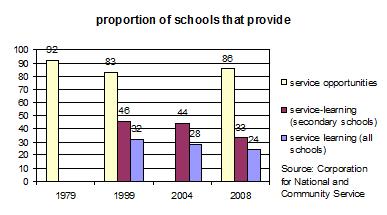
(Des Moines, IA) I’m here to talk to teachers, students, and nonprofit leaders about service-learning: the intentional combination of community service with academic work. This is a big deal–24% of schools offer it. But the prevalence has declined, according to a new study by the Corporation for National and Community Service–down from 32 percent in 1999.

It’s my sense that the movement for service-learning has reached a crisis point. It isn’t included in federal education law; it isn’t a priority in an era of concern about reading and math; the federal funding has been cut (in real terms) since 2001; and the quality of programs is so uneven that outsiders could be reasonably skeptical about its value. On the other hand, the best programs are superb; they fit the outlook of the incoming administration; and there is strong support for service-learning in the Kennedy-Hatch Serve-America bill that both Senators McCain and Obama promised to sign. That bill would direct most resources to poor districts, which today are much less likely to offer service-learning. So we could be poised for improvements in quality, quantity, and eqaulity. Or else service-learning could falter if Kennedy-Hatch isn’t fully funded and the grassroots movement continues to shrink.