Author Archives: Peter Levine

youth unemployment passes 20%

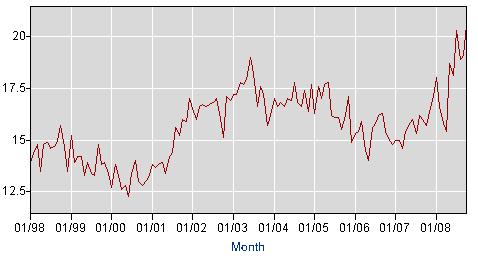
According to the Bureau of Labor Statistics, the unemployment rate for ages 16-19 was over 20% in October. For ages 20 and older, the rate was 5.9%.

Youth unemployment, seasonally adjusted

Unemployed youth are not only missing income and benefits. They are also losing crucial opportunities to develop skills, networks, habits, and experience. The Kennedy-Hatch Serve America Act is certainly not the whole solution, but I think it should be passed quickly as an element of the economic recovery plan. It is an efficient way to give as many as 250,000 young people highly educational work experiences. They will also exemplify public work for Americans of all ages.

truth is not power

(On the USAir Shuttle to DC) Mark Danner in the New York Review of Books:

    However cynically we look to our political past, it is there that we find our political Eden: Vietnam and its domestic denouement, Watergate—the climax of a different time of scandal that ended a war and brought down a president. In retrospect those events unfold with the clear logic of utopian dream. First, revelation: intrepid journalists exposing the gaudy, interlocking crimes of the Nixon administration. Then, investigation: not just by the press—for that was but precursor, the necessary condition—but by Congress and the courts. Investigation, that is, by the polity, working through its institutions to construct a story of grim truth that citizens can in common accept. And finally expiation: the handing down of sentences, the politicians in shackles led off to jail, the orgy of public repentance.

But today, Danner writes, scandals have no repercussions. Powerful people are “exposed” doing bad things and just keep on doing them. “Revelation of wrongdoing leads not to definitive investigation, punishment, and expiation but to more scandal. Permanent scandal. Frozen scandal.”

The present situation is the typical one, I believe, and the Watergate era was an exception. In general, information is not a form of power. Information and analysis are essential conditions of good political action, but they do not cause things to happen. We expect far too much from disclosure and transparency, when we actually need motivated, skilled, and organized citizens. The important truths are already clear enough; we need ways of acting on them.

There is a great old American tradition of believing that publicizing and exposing once-secret facts will influence power. According to the historian Robert Wiebe, the Progressives of 1900-1924 believed that “the interests thrived on secrecy, the people on information. No word carried more progressive freight than ‘publicity’: expose the backroom deals in government, scrutinize the balance sheets of corporations, attend the public hearings on city services, study the effects of low wages on family life. Mayor Tom Johnson of Cleveland held public meetings to educate its citizens. Senator Robert LaFollette of Wisconsin heaped statistics on his constituents from the back of a campaign wagon. Once the public knew, it would act; knowledge produced solutions.” Lewis Brandeis captured this theory in an aphorism: “Sunlight is the best disinfectant.”

The edenic period to which Danner refers, the 1970s, saw a revival of these ideas. John Gardner, Ralph Nader, and their allies were heirs to Brandeis and La Follette. They won and used the Freedom of Information Act, sued corporations to force disclosure of their records, and barraged the media with statistics. Meanwhile, the New York Times fought the Pentagon in the Supreme Court, and Woodward and Bernstein interviewed Deep Throat in a parking garage. Thanks to their efforts, William Greider argued at the time, “information, not dirty money, is the vital core of the contemporary governing process.” This idea could be raised to a very high principle. Dr. King had preached: “We shall overcome because there is something in this universe which justifies William Cullen Bryant in saying truth crushed to earth shall rise again.”

A whole slew of liberal “public interest lobbies” arose, whose role was feed hitherto secret information to the public through the nonpartisan and professional press. David Vogel writes that in the early 1970’s, nearly 100,000 households gave “at least $70 a year to three or more of the following: Common Cause, Public Citizen, ACLU, public television and public radio, and environmental lobbying groups”–institutions that attempted to check power with data. Senator Abraham Ribikoff observed, “instead of the big lobbies of the major corporations dominating the hearings process, you have had practically every committee in Congress according ‘equal time’ to public interest people.”

Today, I sense a revival of the Brandeis theory of power-through-transparency. It is a reaction to the indefensible secrecy-mania of the Bush years, and it embraces the Internet as a powerful new tool for disclosure. But the previous waves of transparency proved disappointing, and we should bear their lessons in mind.

Continue reading

citizens in the economic recovery plan

On Monday, I made a general argument for putting citizens to work (as citizens) on public problems. I had previously argued that this approach would change the relationship between citizens and government from the dysfunctional relationship under George W. Bush and from the relationship of the Clinton years, when government was presented as a helper to relatively passive individuals.

It’s worth thinking about this philosophical shift in relation to our most urgent immediate problem: economic recovery. The Bush bailout and stimulus efforts have involved almost no accountability or transparency. The money has not been directed to ordinary Americans or used for important public purposes. We can do much better by combining Barack Obama’s call for “service and active citizenship” with his economic recovery plan.

In policy terms, putting citizens to work on economic recovery means:

  • Passing and fully funding the Kennedy-Hatch Serve America Act (which Senator Obama cosponsored) as a contribution to the economic recovery
  • Enlisting citizens to provide guidance and accountability when public money is used for the economic recovery. Tools for participation can include:
    • Public deliberations at the local level about priorities for spending
    • Citizens’ review panels that complement (not replace) professional oversight by government auditors
    • Web-based tools to disclose details about spending and invite public discussion and input
    • Civil servants supporting such work by citizens as part of their job descriptions
  • Creating jobs programs within various agencies and policy domains that involve the participants in planning and learning. HUD already funds YouthBuild to construct houses and teach civic skills. This is a model for other agencies.
  • Civil service reform to make public sector jobs more attractive to younger people and to promote partnerships between agencies and non-governmental groups.
  • A renewed focus on civic education in k-12 schools, colleges, and youth employment programs, so that young people learn how to discuss and analyze public problems as part of their preparation for the work world.

mapping Boston’s civil society

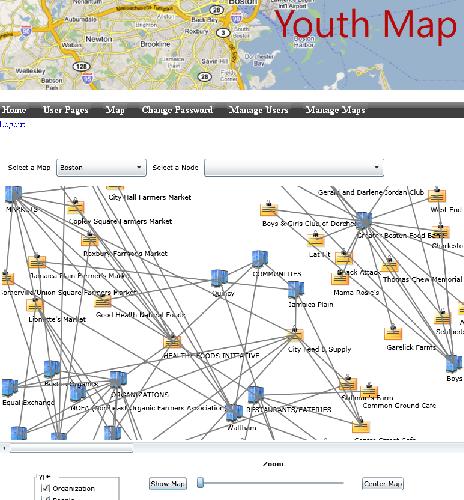
We’re busy mapping Boston. Students place nodes that represent people, ideas, or organizations on a blank plane. Each node stores data, such as contact information, goals, activities, and geographical locations. Connections among nodes represent real collaborations. The data can be shown in lots of ways–on a geospatial map, as a network diagram with various center-points, as a list of search results. Ultimately, this software will be an application for Facebook and MySpace, making it easy for people to add or use data . For now, we have a standalone website.

Here’s a screenshot from today. This represents the work of just a few Tufts undergrads over a couple of weeks. We’re already working with students at UMass Boston and will be expanding beyond those campuses in the spring. The software is also capable of automatically harvesting organizations and links from the Web and pasting them here to be analyzed by human beings.

Purposes:

  • Recruiting people and organizations. One can search for individuals who are connected, even indirectly, to a given issue and then ask them to participate in events or projects.
  • Finding opportunities. One can search for places to volunteer, give money, or organize politically. The search can be by key-word. More interesting is to search for organizations that are linked to other organizations.
  • Analysis and deliberation. One can link two issues together, or link an issue to an organization, and then debate the connection. Is homelessness worsened by zoning? That hypothetical connection can be discussed on the map itself.
  • Broadening sources. Journalists, government agencies, foundations, and researchers tend to ask the same people for information and opinions. They often rely on formal credentials as evidence of knowledge. The network map can lead them to overlooked citizens who are useful sources because of the social roles they play.
  • Investigations. One can look for inappropriate or problematic connections, or lack of connections.

Issues that students have brought up so far:

  • Privacy: Whose information should go on the map, and who decides that?
  • Chilling effects: Would people be discouraged from linking to controversial organizations and causes if their links could be mapped?
  • Spam and other bad stuff: Inappropriate content can be added to the map
  • Marketing: Instead of recruiting volunteers or activists for a social cause, a company could use the map to find influential customers.
  • Sustainability: It’s fun for me and my colleagues to build the map. But other people who contribute need to know that it will still be there (and kept current) in five years.
  • Limits: This is a Boston area map. That geographical definition gives it useful density. But Darfur could belong on the map, since Boston-area students work on Darfur. Former Bostonians could place themselves on the map. Is there any point to a geographical limit?