Author Archives: Peter Levine

free advice

My childhood friend Chris Kutz, now a law professor at Berkeley, has organized a blog that consists only of policy proposals by Cal colleagues, including several famous professors. It’s called Blue Sky: New Ideas for the Obama Administration. Here is an op-ed in the San Francisco Chronicle that announces it.

Meanwhile, Tufts University, where I work, has a webpage entitled “Memo to the President: Faculty weigh in with advice for Barack Obama as he begins his term.” It’s not a blog, but each professor contributes a few paragraphs that remind me of blog posts.

These pages make me wonder …

  • How many other institutions are also organizing their faculty to write short public memos for the new president?
  • Is there much more of this in 2008 than ever before? (So it seems to me, but I could have missed such sites in 2000 and 2004.)
  • If so, what’s the stimulus? I can imagine that more faculty admire Obama than have liked any president in my adult lifetime; that blogging has made professors more prone to write and publicly post short opinion pieces; and that the Presidential Transition Team prompted people to write this sort of statement by inviting comments on change.gov. Those are hypotheses; I don’t know the real story.
  • Assuming that this kind of site is a common development, what does it mean? Is it a sign of productive faculty engagement in public life? A welcome turn to transparency (since earlier generations of faculty would have sent private letters to the president)? A rather quixotic or naive activity? Or a sign of professorial arrogance? I am personally enthusiastic, but this seems a worthy topic of discussion.
  • What will happen after the new administration settles in? Will this kind of activity continue, or turn into something different, or go away?
most people aren’t going to college

Reporters and others consistently equate youth with college students. Going to college is treated as the norm, and those who don’t enroll are seen as some kind of exceptional minority that needs help with “college access.” I’ve also heard the argument that college is the best time to develop civic and ethical skills and values.

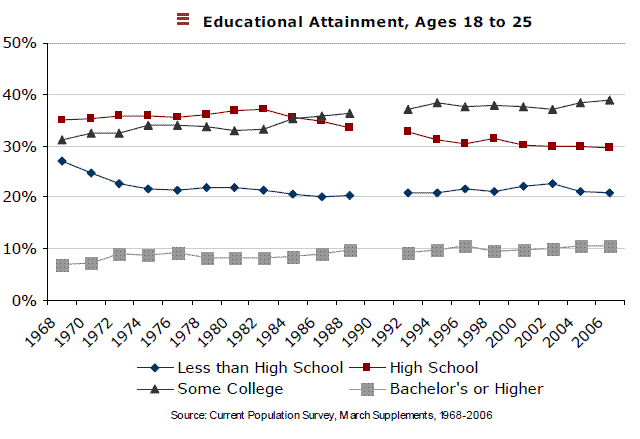
It is therefore essential to understand that most young adults do not attend college, even 2-year or community college. The norm is to finish one’s education at high school. Nor have rates of college attendance budged upward for decades. CIRCLE’s fact sheet (PDF) shows the flat trend:

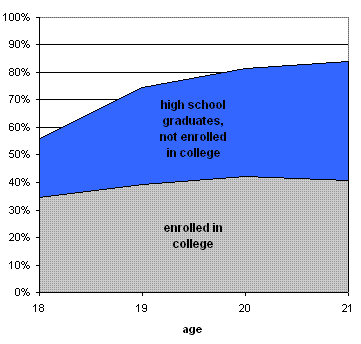
Another way to show the current situation comes from a new Bureau of Labor Statistics report (pdf), which uses the National Longitudinal Survey of Youth 1997, “a nationally representative survey of about 9,000 young men and women who were born during the years 1980 to 1984.” This is my graph derived from that report:

It shows that during the traditional “college years” (ages 18-21), the proportion of young adults who are actually in college never reaches 40%. To be sure, some of the others will obtain college credits–and even bachelors degrees–during their lifetimes. (The fact that you can attend college at any point makes it hard to say what the college matriculation and graduation rates are for a given generation–we only really know after they all die.) But it’s clear that the norm is not to go to college when one is of conventional “college age.”

I’m in favor of getting more young adults on a college path, to the extent that’s possible. But we are nowhere close to enrolling everyone, and it’s not obvious that that would even make economic sense. Thus it is essential not to reserve enriching, rewarding, and remunerative opportunities for the minority of people who go to college. We also need to watch our language and our assumptions–“youth” doesn’t mean “college student,” and college attendance is not (in any sense) the norm.

Aert de Gelder, “Rest on the Flight to Egypt”

This painting, from about 1690, is one of my favorites in our new home town of Boston. (It’s in the Museum of Fine Arts.) The “Rest on the Flight to Egypt” is an old subject for paintings, going back to the middle ages. It illustrates Matthew 2:12-14:

    And being warned of God in a dream that they should not return to Herod, they departed into their own country another way. And when they were departed, behold, the angel of the Lord appeareth to Joseph in a dream, saying, Arise, and take the young child and his mother, and flee into Egypt, and be thou there until I bring thee word: for Herod will seek the young child to destroy him. When he arose, he took the young child and his mother by night, and departed into Egypt.

For some reason that I don’t know, artists have (for many centuries) chosen to depict the little family pausing on the way to Egypt. That makes an acceptable subject for a Protestant, because it’s a “history painting”–an illustration of something that really happened, according to the Bible. In contrast, a painting of the “Holy Family” or the “Virgin and Child with Saints” would be problematic from a Protestant perspective. Those extremely common subjects developed as Orthodox and Catholic devotional objects, as icons or stimuli to prayer and meditation. For Protestants, they verge on “graven images.”

De Gelder (a student of Rembrandt) was a Protestant, but he has found a way here to imitate a “Holy Family” or a “Madonna and Child with Saint.” Joseph resembles St. Jerome in a painting of a sacra conversazione. And (as my wife Laura notes) the Madonna’s halo has migrated onto Mary’s extraordinary circular, gold-rimmed hat.

I take no sides in the Protestant/Catholic debate about religious images. But I think the shift from a Madonna and Child to a history painting has produced wonderful effects in this particular work. Since the baby is not an object of veneration, he can act like a real infant–snuggling down into his mother’s lap instead of being displayed upright. Joseph reads a grown-up book, presumably for the edification of the adults in the family–but he pauses to gaze affectionately at his newborn (holding his place with his finger). It’s an affectionate representation of a human family, with subtle echoes of the grand Catholic tradition.

biochar

I lack all relevant scientific expertise, but biochar sounds very promising to me. Basically, the idea is that you burn “biomass” (crops, trees, used paper, kitchen waste, etc.) with minimal oxygen. You can accomplish this by getting a fire going and then covering the biomass with soil while it smolders–the ancient technique–or by burning it in a special kiln, or even by microwaving it. This process produces the following products, in a ratio that you can control:

1. A stable form of carbon that will not return to the atmosphere for at least hundreds of years. This product also makes an excellent fertilizer.

2. Various valuable chemical byproducts.

3. Three forms of fuel: solid (charcoal), liquid (oil), and gas.

If all we wanted to do was mitigate global warming by removing carbon from the air, we could grow crops (which pull carbon out of the atmosphere), burn them in kilns, and store vast quantities of biochar in its stable form. But that’s expensive to do on a massive, global scale. The other uses of biochar–as fertilizer and fuel–make it economically valuable.

When people burn biochar as fuel, they do put carbon back in the atmosphere. But the fuel is highly efficient, and you can keep the residue as stable carbon. The result is a fuel that actually lowers atmospheric carbon when you combine its production and its use. If we substitute biochar for coal or oil extracted from under the earth and then burned, the benefit is huge. Likewise, if instead of creating arable land by setting rain forests on fire, we turn trees into biochar fertilizer, we can produce productive farmland with dramatically less damage.

Biochar could be produced on an industrial scale by firms or agencies that would sell biofuel to replace fossil sources, such as coal and oil. It could also be produced by households or villages for their own local use. That opens the possibility of a decentralized process that could be socially empowering. To get this going, it might be helpful (I’m speculating here) to invest public funds in developing new kilns and processes.

Nothing is a panacea, and some skeptical points are listed here. But overall, this sounds like the most promising strategy I’ve heard of.