Author Archives: Peter Levine

coming of age in a winner-take-all society

These are some winning words from the National Spelling Bee, by year:

1932: knack

1940: therapy

1973: vouchsafe

1975: incisor

2001: succedaneum

2004: autochthonous

The tremendous increase in difficulty is sometimes taken as evidence of rising achievement (e.g., in Strauss and Howe’s book, Millennials Rising.) But compare the national achievement rates in reading, as measured by the Federal Government’s National Assessment of Education Progress:
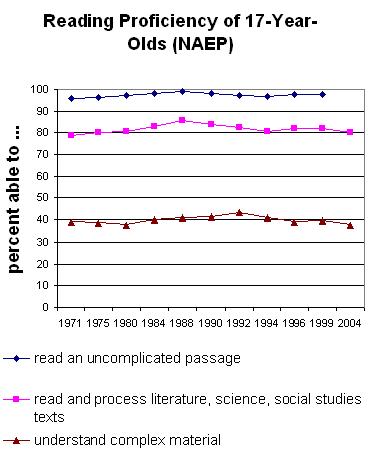
High school reading scores are totally flat, and far from adequate in a competitive, 21st-century economy. (And these results reflect only youth who are still enrolled at age 17; one third drop out before graduating.)

This pattern seems to be a perfect example of what Robert H. Frank calls the “winner-takes-all” society. It only takes a few superb contestants to make an entertaining national Spelling Bee competition that’s fit for TV. Given the rewards of winning, hundreds of thousands of American kids will enter, and the very best will rise to the top. The Spelling Bee process doesn’t have any relevance to, or direct effect on, the remaining 99.999% of kids.

By itself, that’s not a problem–in my opinion, awesome spelling achievement is a parlor trick that any computer can perform to perfection. But the same logic applies to more important competitions as well: admission to an engineering school, becoming a partner in a law firm, being drafted to the NBA, getting a seat in an orchestra, or making tenure at a good university. The few who make it to the top win bigger rewards than ever before, because the process of selection is increasingly efficient and the base of contestants is larger. The excellence of the winners is impressive. But the effects on the rest of the population are problematic, at best.

a new book on the way

Palgrave Macmillan has offered me a contract to publish my “Dante book” (which needs an actual title–and I’m not sure what that should be). I have been working on the manuscript for 14 years, and it has gone through many profound structural changes as my thoughts have evolved and as I’ve assimilated useful criticism. It is great to think that the project will be done and between covers within months.

Here is the beginning of the introduction:

    This is a book about ethics or morality and fiction. Ethics encompasses what is right or good, what we ought to do and think, and how laws and institutions should be organized. I argue that we should often make ethical judgments and decisions by describing reality in the form of true narratives. Fictional stories provide excellent opportunities to deliberate about situations and issues that also occur in real life, and should be read, in part, as ethical statements. I argue that when the moral judgments supported by a good story conflict with general principles, we ought to follow the story and amend or suspend our principles, rather than the reverse. What makes a story “good” for this purpose is not its conformity to correct moral principles, but its merits as a narrative—for instance, its perceptiveness and coherence and its avoidance of cliché, sentimentality, and euphemism.

    The relationship between stories and moral principles is connected to other issues that I also explore: the proper role of emotion and reason in ethics; the scope of ethical judgments (i.e., how widely or in how many different contexts a given judgment ought to apply); cultural diversity and what that means for morality; partiality, or whether it is appropriate to favor people whom one knows; what kinds of context are relevant to the interpretation of literary texts; and the value of fictional versus true narratives.

This is a book of humanistic scholarship: specifically, literary criticism and moral philosophy. Those are my roots, even though I spend almost all my time on quantitative social science or policy analysis. My day job is to study and promote “civic engagement” or “active citizenship”; and it has proved useful to study those topics empirically. (Hence CIRCLE.) I don’t think either phrase appears in this book manuscript. But there is a deep connection in my mind, which I hope to make explicit in a later project.

The thesis of my “Dante book” is that an indispensable technique for moral judgment is the description of concrete, particular situations in narratives. I argue that no set of principles, no procedure, no algorithm for weighing values, and no empirical data could ever replace this process of description. It is an art and a skill; some people practice it better than others, and it can be taught. But it is not the special province of any credentialed experts, such as lawyers, economists, or moral philosophers. It cannot be replaced–even in a distant utopia–by rules or systems.

In my “Dante book,” I draw some conclusions about the purposes and methods of the humanities. (In fact, it has been suggested that I entitle the volume, Dante’s Moral Reasoning: Reforming the Humanities.) In my other work, I follow the implications beyond the academy into the domain of politics. We cannot tell what is right and good unless active, engaged citizens discuss concrete cases. They will only be motivated to discuss and to inform their conversations with experience if they have practical roles in self-government. That is the fundamental connection between my two main interests: moral judgment and civic engagement.

hot-potato socialism

The New York Times asked Barack Obama whether he was a “socialist.” He said no and then called back, saying, “It was hard for me to believe that you were entirely serious about that socialist question.” The word is incendiary in American politics, and the president was obviously taken aback and perhaps concerned that his answer had not be forceful enough. But those of us who are not automatically appalled by the word “socialism” can reasonably ask whether we are on a socialist path. After all, the government is considering owning banks and providing universal health care.

I don’t think there’s a consensus definition of the word; distinguished thinkers have used it in various ways. From a rigorously libertarian perspective, any taxing and spending is socialist unless it is essential to protect individual freedom. So any government that funds things other than the police, courts, jails, and the military with mandatory taxes is socialist. But that means that every functioning government is socialist; the only question is to what degree. In the United States, marginal tax rates are much lower than they were in the 1950s, but are likely to rise by the equivalent of a few percent of GDP.

In short, if the tax rate is the issue, than we are less socialist than we’ve been for most of the 20th century and less socialist than other countries, but every society is socialist. Since this conclusion seems unhelpful, I would define the word in a more radical and precise way. A socialist society, in my view, is one in which “the people” own the major productive assets, things like farms, factories, and service industries. “The people” cannot own something in the same way that I own my cell phone. Private ownership means that my wishes directly affect the object; I can use, alienate, or destroy the object pretty much at will. “The people” cannot do that, because they are plural. If they disagree, they do not all get what they wish. And even if they are unanimous, each may not feel that his or her preferences caused the outcome.

Still, it is plausible to talk of public or popular ownership in several situations. A government can own a productive asset and can represent the people through a combination of regular competitive elections, negotiation among parties, and freedom of speech and debate. Or the workers in a given firm or farm can own it as voting shareholders. Worker ownership might be considered popular ownership of the economy as a whole, if everyone were a worker somewhere. In the Communist Manifesto, 6 out of 10 planks related to state or worker ownership of productive assets.

By this definition, the functioning societies of today do differ in how socialist they are. It is common for European democratic governments to own and directly manage major industries, such as arms manufacturers, railway lines, and oil companies. There is very little such ownership in the United States.

Nor is “socialism” (so defined) even a remote possibility here. The most radical proposal for health care reform–which no one gives any serious chance of passing–is Single Payer, under which the government would fund health care. But the doctors, hospitals, and drug companies would still be private enterprises and would compete for customers. The government may end up possessing banks, but only by default and for the shortest possible time. That sounds like “hot-potato socialism,” if it is socialism at all.

snapshots from February and March

Out of the bathroom window in the middle of the night, a scene from an expressionist painting. The moon, too large, glares through black tree limbs. Snow forms a smooth shape, a pearly pool, amid the trunks. Houses stand at crazy angles.

    Two people walk through the cold naked grove;
    The moon goes with them, they gaze at it.
    The moon slips over tall oak trees;
    No cloud obscures the heaven’s light
    Into which the black spikes reach.

    (From Richard Dehmel, Zwei Menschen, 1903)

A woman is running, screaming up Winter Hill in Somerville toward a gas station, where a knot of people stands. One of them is a police officer. Her dog lies on his side as if asleep.

False spring on Brattle Street: grand Victorian houses, an anthology of architectural styles. Joggers, toddlers in strollers, buds on the manicured foliage.

On a beach near Gloucester, the vacation houses have a slum-like look. They are small and boarded-up for winter; the streets are deserted in the cold sea air. There’s a game of horse-shoe on the sand, and dogs run joyfully in the surf.

flypmedia’s “meet the millennials”

I happen to be quoted/filmed in this FLYP cover story, which contains lots of good, basic information about today’s young voters. But I recommend it for a different reason: it’s a great example of multimedia journalism, complete with charts, text, music, and embedded videos. I’m more of a linear, one-paragraph-at-a-time kind of reader, but this format is obviously compelling and I’m not sure I’ve seen anything like it before.