Author Archives: Peter Levine

the purposes of the humanities

I just heard an anecdote: several candidates for president of a major university were asked about the purposes of the humanities. All but one talked in terms of “art appreciation.” As a result, the committee–which included scholars from the humanities–selected the one remaining candidate, who understood how to talk like a modern humanities professor.

This anecdote reminded me of a scientist whom I used to hear holding forth to his graduate students at a take-out restaurant in College Park. Once he advised them to take an art appreciation course to meet women. Apart from other problems with this advice, the University of Maryland does not offer art appreciation. It offers art history, a discipline that sees itself as just as rigorous as the natural sciences.

Within the humanities themselves, I think the prevailing view is almost the opposite of this scientist’s. Rather than teach “appreciation,” we teach critical distance. A major goal of a class in English or art history is to help students learn how cultural products are made and how they function so that the students shed their automatic reactions and assumptions. When we understand works of art and literature, sometimes we like them more, but sometimes less. The point of a humanities course is not to raise or lower approval, but to enhance critical understanding.

My own view is that critical distance is a moral stance, and often a good one; but it is only an example of a moral position. In general terms, the purpose of the humanities is ethical thought. What ethics demands is sometimes criticism, but sometimes it is tolerance, solidarity, or even appreciation. The sciences and social sciences provide information relevant to ethical choices, but they deal with “is,” not “ought.” Only the humanities address, in various ways, the questions of how one should live and how a society should be structured.
Arne Duncan on schools as community centers

I happen to be flying to Chicago today for a meeting on young people and civic engagement. The Chicago Public Schools were led by Arne Duncan until President Obama made him Secretary of Education. Many people who want to elevate democratic (or civic) education from its lowly status in the Department have hopes for Secretary Duncan. He was, for example, supportive of the Mikva Challenge, a great program that enlists Chicago teenagers in constructive political action and teaches them academic and political skills. In the clip below, he eloquently defends the idea of the school as a community center–also a concept with roots in Chicago, the city of John Dewey and Jane Addams.

I got this clip from the excellent Coalition for Community Schools, which has landed the Secretary for its conference.

an accelerating cascade of pearls (on Galileo and Tintoretto)

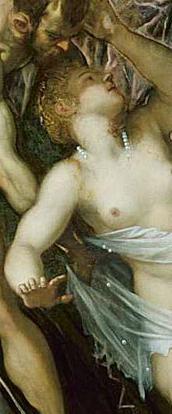
This is a detail of Tintoretto’s “Tarquin and Lucretia” (1578-1580), which belongs to the Art Institute of Chicago but is now in Boston for the astounding exhibition entitled “Titian, Tintoretto, Veronese: Rivals in Renaissance Venice.” (Probably never before have so many comparable paintings by these competitors been hung together.)

In the detail, pearls are strewn across Lucretia’s clothes; Tarquin has just broken the strand. The spheres are caught on their way downward, spaced at growing intervals.

People have always known that objects move, and have always depicted motion in still images–since the ancient cave paintings. But I think Tintoretto’s painting may reflect a new way of thinking about motion and space. The image represents a precise instant at which each pearl would occupy a different and predictable location because of the mathematical laws of nature. The objects are frozen, but their locations allow us to infer their movement.

Galileo revolutionized science by claiming that nature was a book written in the language of mathematics. Tintoretto painted Galileo’s portrait from life in 1605-7, which shows that the two geniuses knew each other. By 1638, Galileo had proved (either in a real experiment on the Tower of Pisa, or in a thought-experiment) that objects of different weights would fall at the same accelerating rate. And forty years later, Tintoretto was interested enough in this Galilean conception of time and space that he painted pearls accelerating down Lucretia’s chest. It was another thought-experiment.

In Tiepolo’s “St. Dominic Instituting the Rosary” (1737-9), the rosary itself plummets at high speed from an enormous sky painted on the ceiling of the Gesuati Church in Venice. That is an excellent example of baroque theatricality, but not a unique one. By then, Europeans automatically thought of motion in Galilean terms. Tintoretto was perhaps the first to paint that way.