Category Archives: populism

how not to talk about The People

Maria Bartiromo (Fox News): As the commander-in-chief, as the president of this great country, what can you do to bring us together?

Donald Trump: Our people are so incredible. …  Do you know, there’s probably never been a base in the history of politics in this country like my base. I hope the other side realizes that they better just take it easy.

As Jonathan Chait notes, Trump equates “us,” the people of America, with “the people who voted for him.”

This is the rhetorical move that Jan-Werner Müller, in his globally influential book (2016), uses as the definition of “populism.” Populists “claim that they and they alone represent the people. All other political competitors are essentially illegitimate, and anyone who does not support them is not properly part of the people. … Elites are immoral, whereas the people are a moral, homogeneous entity whose will cannot err.”

Müller has previously quoted Trump–“the only important thing is the unification of the people – because the other people don’t mean anything”–as evidence that the current president is a populist, in this bad sense of the word.

I agree that the slippage between Trump’s supporters and “the people” is a very bad sign. However, it is not straightforward to define populism (meaning a problematic phenomenon) in this way. Trump says many things and is inconsistent in his appeal to “the people.” Meanwhile, a wide variety of political actors also depict the public as a homogeneous entity that is on their side.

Some of them define “the people” in racial or ethno-national terms. That tendency seems more accurately described as racism or xenophobia than as populism, especially if anti-racists like Venezuela’s Hugo Chávez count as populists (as Müller would suggest).

And sometimes it is the strongest champions of democratic institutions who use rhetoric that looks populist according to Müller’s definition. For instance, Jimmy Carter presented himself as an ordinary American (a peanut farmer and a Christian, not a Washington politician) who could best reflect the values shared by all Americans (Johnstone 1978). Carter invoked a unitary public and promised to connect directly to the people, unmediated by interests and organizations. His Inaugural Address could be coded as populist rhetoric, in Müller’s sense of the word. Yet Carter was committed to constitutional limits, respected his critics and the opposition, and made the promotion of democratic freedoms a centerpiece of his agenda.

Thus it is not clear that searching for Müller-style populist language will identify actors who are hostile to democratic institutions and processes. There is an upsurge of repression around the world—and it is not limited to racists and xenophobes—but there is a better word for it than “populism.” That word is “authoritarianism.”

For the purposes of empirical research, I would dispense with “populism” in the Müller sense and look instead for authoritarianism and racism as distinct but sometimes overlapping phenomena that are ascendant in our time.

Müller is, however, right that there are pitfalls to invoking a unitary public that is on one’s side–or defining one’s side as “the people.” This is an excuse for trampling on rights, whether your opponents are demographic minorities and immigrants (the right-wing variant), or corporations and the rich (the left-wing version), or extremists (the centrist version). It’s always better to recognize the legitimacy of the actual human beings who disagree with you and who vote for the other side.

Citations: Jan-Werner Müller, What Is Populism? (Philadelphia; Universoty of Pennsylvania Press, 2016), p. 101; Christopher Lyle Johnstone, “Electing Ourselves in 1976: Jimmy Carter and The American Faith,” Western Journal of Speech Communication, vol. 42  Issue 4, *Fall 1978), p. 241-249. See also Trump at the confluence of populism, chauvinism, and celebrityfighting Trump’s populism with pluralist populismseparating populism from anti-intellectualism and two kinds of populism.

coming soon: Democracy’s Discontent and Civic Learning

Now available for pre-ordering is Charles S. White (ed.), Democracy’s Discontent and Civic Learning: Multiple Perspectives. Chapters include:
  • “The Populist Moment,” by William A. Galston.
  • “Populism, Democracy, and the Education of Citizens,” by Thomas S. Vontz and J. Spencer Clark, (with Stephen L. Schechter).
  • “Are Europe’s Democracies in Danger? A View of the Populist Challenge,” by Karlheinz Duerr.
  • “Confronting a Global Democracy Recession: The Role of United States International Democracy Support Programs,” by Liza Prendergast
  • “Democracy’s Pharmakon: Technology as Remedy and Poison,” by Charles S. White.
  • “Judicial Legitimacy in the Age of Populism,” by Alison Staudinger.
  • “Fulfilling the Promise of Democracy: How Black Lives Matter Can Foster Empowered Civic Engagement,” by Amy J. Samuels and Gregory L. Samuels.
  • “Does P–12 Educational Research Ameliorate or Perpetuate Inequity?” by Jacob S. Bennett.
  • “Democracy’s Discontent and Teacher Education: Countering Populism and Cultivating Democracy,” by Stephanie Schroeder.
  • “A Primer on Trump Economics: Populist or Something Else?” by James E. Davis.
  • “Going for Depth in Civic Education: A Design Experiment,” by Walter C. Parker. With responses:
    • “What Public Philosophy Should We Teach? A Reply to Parker,” by Peter Levine
    • “Fidelity of Implementation: A Reply to Parker,” by James E. Davis
    • “Contrasting Landscapes: A Reply to Parker,” by Karlheinz Duerr

Trump at the confluence of populism, chauvinism, and celebrity

Donald Trump says many things. Some are innocuous and banal. Quite a few are inconsistent. And some provide evidence that he belongs in these three categories:

  1. A “populist” in the particular sense proposed by Jan-Werner Müller. (I also like to retain more positive definitions of the same word.) For Müller, a populist is someone who believes that the whole authentic people is unified behind a set of values that the populist leader explicitly expresses. Therefore, the opposition is illegitimate. Elections that favor the populist leader are sacrosanct, and anyone who criticizes or strives to reverse these results is an enemy of the people. But elections that challenge the populist must have been rigged or stolen. “A los amigos, justicia y gracia. A los enemigos, la ley a secas.”
  2. A chauvinist, meaning someone who explicitly and apologetically favors an in-group and disparages an out-group. In the United States, racism is a major variety. But in some other countries, the leading chauvinists are inspired by religion or nationality instead of race.
  3. A media personality who projects a combative personality, who disparages opponents, who cultivates “outrage,” who “seem[s] to always react to controversy and even aversion by leaning into it,” and who claims honesty or authenticity on the basis that he says things that give offense or cause pain–except not to his core audience. This style is prevalent on talk radio, certain reaches of cable news–but equally important, in supermarket tabloids, WWF, and reality TV shows like The Apprentice.

These three categories need not intersect. You can be an outrageous media personality who isn’t a populist or a chauvinist, a chauvinist who isn’t a celebrity, etc.

None of these categories is new. White Supremacy has been near the center of American politics since the beginning. Various forms of populism and chauvinism were much more extreme around the world in 1939 than today. But there does seem to be a global boom of unapologetic chauvinist populists who use media effectively.

The right doesn’t own these categories, and the left doesn’t consistently avoid them. I know plenty of people who believe that the Tea Party is pure Astroturf, a creature of right-wing billionaires. That is a populist move in Müller’s sense: it declares a large number of actual Americans to be illegitimate participants in politics. By the way, it’s different if you hate and fear your political opponents. That is partisanship, but not populism, so long as you acknowledge that your opponents are fellow citizens and you must share politics with them.

We’ve seen plenty of examples of these categories, but we have never had a president who fits all three. The combination poses a severe threat to our institutions and world peace.

Insofar as the problem is populism (in Müller’s sense), then I think an electoral shellacking will be the best remedy. Even if Republicans lose the 2018 election badly, the strongest Trump supporters (30-40% of the population) will continue to think that he speaks for the whole genuine American public and the election was rigged. However, Trump can’t govern without conservative and business elites. I think they will abandon him if they see that he is dragging them into the minority.

By the same token, if Republicans do better than expected in ’18, and/or Trump is reelected, we are in for much more populism. And if Trump’s presidency ends for a relatively extraneous reason, such as personal criminality, then the picture will be muddy enough that populism will remain an attractive option. (I often think that we are fortunate in our populist; if he were smarter and more disciplined, we would really be in trouble.)

Apart from elections, we have two other assets in the struggle against Müller-style populism. One is pluralist populism , which portrays “the people” as highly diverse (I discuss that rich tradition here).

The other is genuine conservatism. Real conservative thought is diametrically opposed–in principle–to the idea that any government can ever be authorized by a unitary public. The left/right spectrum originated in the French Revolution, and the Jacobin left was the populist side, in Müller’s sense. Conservatism emerged in reaction to the revolutionaries’ claim to a popular mandate, and great conservative thinkers have always opposed such claims. Many Republican politicians will go along with Trumpian populism as long as it wins elections; but conservatives will denounce it from the rooftops. The question is how many conservatives actually exist.

Insofar as the problem is chauvinism (meaning, in the USA, racism, religious bigotry, and sexism), then it’s the next chapter in a basic American story. Progress is hard-won and tends to have a zigzag pattern. I am a fan of Barack Obama for other reasons than his race, but it is significant that he was the first leader of a majority-white nation to have modern African ancestors–and the first US president in modern times to have a foreign father. That was the zig; Trump is the zag. The struggle continues.

Finally, insofar as the problem is celebrity politics, I am actually optimistic. I believe that Trump came first in a crowded and splintered Republican primary field because his persona appealed to a minority of the US population. He then beat Clinton in the Electoral College because partisan polarization gave him most Republican votes in key states, and she was deeply unpopular. Compared to a generic incumbent president who enjoys a strong economy and who hasn’t actually passed any controversial legislation (other than a tax cut), Trump is remarkably unpopular. And a key reason is his style. So I think acting like a reality TV star exacts a political cost and is not likely to be replicated.

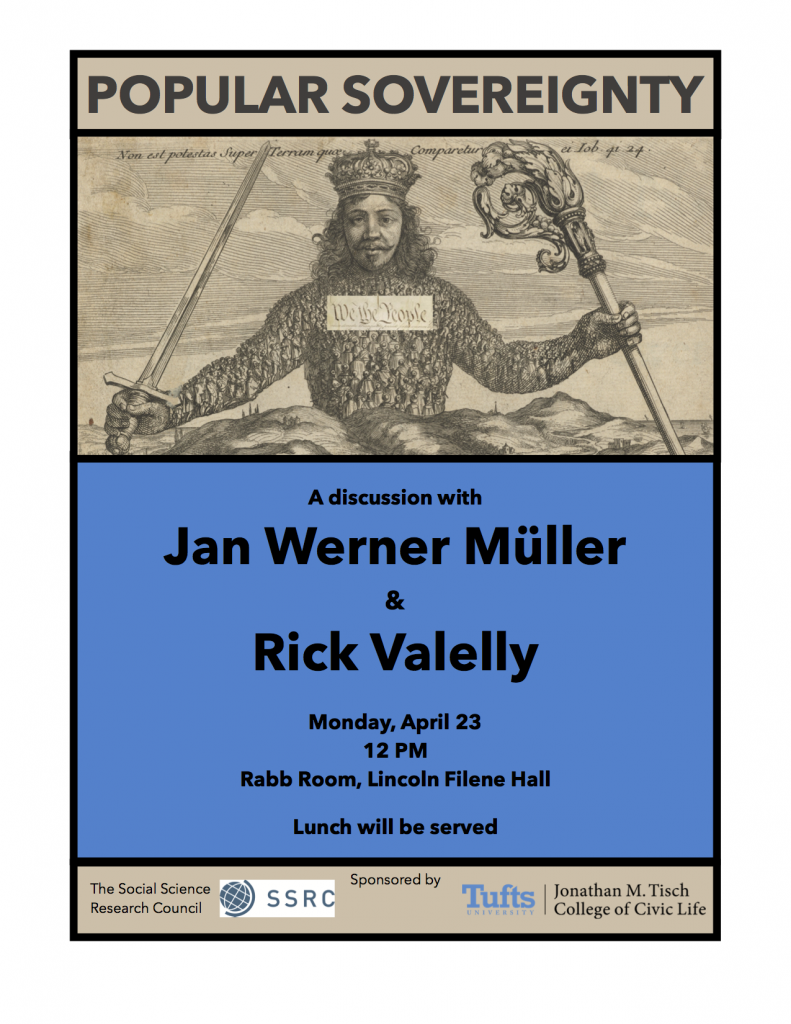
Jan-Werner Müller and Rick Valelly at Tisch College

Join Princeton’s Jan-Werner Müller (author, most recently, of What is Populism? which has been translated into more than 20 languages in two years) and Swarthmore’s Rick Valelly (author of The Two Reconstructions: The Struggle for Black Enfranchisement and many other books) for a discussion at Tisch College on Monday, April 23


Building Civic Capacity in an Era of Democratic Crisis by Hollie Russon-Gilman and K. Sabeel Rahman

About $3 billion was contributed to influence 2016 federal campaigns. In a new paper entitled “Building Civic Capacity in an Era of Democratic Crisis,” Hollie Russon-Gilman and K. Sabeel Rahman suggest a much better way to spend some of that money.

I realize, by the way, that political donors want candidates to notice their support. It would nevertheless make all the difference if they gave one percent of their $3 billion to activities that strengthen democracy–compensating for irradiating the body politic with polarizing and demoralizing messages. Progressive donors would also build the base for more progressive policy by investing for the longer term.

Russon-Gilman and Rahman argue “that today’s populist moment emphasizes the need to create a genuinely responsive, participatory form of democratic politics in which communities are empowered, rather than alienated.” They advocate investments that “self-consciously strive to build constituencies and identities that are more inclusive and accommodating. Think of this as ‘us’ populism, as opposed to ‘them’ populism.”

That basic stance supports two strategies:

  1. More investment in community organizing, especially the types that build “new bridges across racial, gender, and geographic divides.” Russon-Gilman and Rahman advocate broad-based, long-term organizing instead of mobilizing people around specific issues.
  2. “Reforming our institutions of governance” so that agencies offer citizens more “hooks and levers” to influence power, and so that public sector workers have skills and incentives to engage the public better.

These strategies imply (as the authors note) a broad understanding of democracy. It is not all about elections, nor even about the official government. It’s about how people come together and exercise power.

The paper offers valuable case studies. For instance, under the heading of organizing:

  • “The Center for Rural Strategies (CRS) … based in Whitesburg, Ky. in the central Appalachian coalfields, provides rural communities and nonprofit organizations with resources on innovative media and communications strategies in order to strengthen their work.” CRS provides information, challenges stereotypes about its communities, and lobbies for better access to the physical infrastructure for communications, because both content and conduit matter. (See “Building Democracy in ‘Trump Country’” by Ben Fink for a similar case.)
  • “Coworker.org (Coworker) is a digital platform for workers’ voices founded in response to the decline of formal institutions organizing workers and geared towards building a twenty-first century model of worker power. The organization provides tools directly to workers to self-advocate within the workplace, usually where no labor structure or organizing already exists.” Like CRS, Coworker invests in people who develop as leaders.

Examples under the heading of institutions include:

  • “The Office of Community Wealth Building (OCWB) was established as a permanent city agency in Richmond, Va., in 2015 to provide anti-poverty strategy and policy advice to the mayor and to implement municipal poverty reduction initiatives and systemic changes around housing, education, and economic development.”
  • “The Public Engagement Unit (PEU) is a division in New York’s city government started in 2015 [is] devoted to knocking on doors and making calls to hard-to-reach constituents to enroll them in city services, as well as foster long-term individual relationships with city staff.”

Overall, “Building Civic Capacity in an Era of Democratic Crisis” helps make the case for investments that are less short-term, less oriented to immediate efficiency, less split between government and civil society, but more experimental, more open-ended, and more truly inclusive than we normally see (especially, I would say, on the left).

See also: why the white working class must organizeto beat Trump, invest in organizingfighting Trump’s populism with pluralist populism; and community organizing between Athens and Jerusalem.