scholarship on engaged scholarship

We are accepting application for the APSA Institute for Civically Engaged Research (ICER) at Tisch College until March 31. In preparation for the Institute, I am looking for good writing about civically engaged research that is relevant for political scientists, although not necessarily about political science per se.

Incidentally, ICER will not be mainly devoted to reading and discussing papers; it will be more like a workshop. But readings are useful for the organizers at least, and a few texts may be assigned.

A diversity of perspectives and agendas, methodologies, topic areas, and authors’ backgrounds and social identities is important.

I’ve got these but would welcome additional suggestions. (This post is a bleg.)

  • Ackerly, Brooke, and Jacqui True. “Reflexivity in practice: Power and ethics in feminist research on international relations.” International Studies Review 10.4 (2008): 693-707.
  • Burawoy, Michael. “For public sociology.” American sociological review 70.1 (2005): 4-28. (His ASA Presidential Address)
  • Flyvbjerg, Bent. “Social science that matters.” Foresight Europe 2 (2005): 38-42.
  • O’Meara, K., Timothy Eatman, and Saul Petersen. “Advancing engaged scholarship in promotion and tenure: A roadmap and call for reform.” Liberal Education 101.3 (2015): 52-57.
  • Ostrom, Elinor. “Beyond markets and states: polycentric governance of complex economic systems.” American economic review 100.3 (2010): 641-72. (Her Nobel Lecture)
  • Struminska-Kutra, Marta. “Engaged scholarship: Steering between the risks of paternalism, opportunism, and paralysis.” Organization 23.6 (2016): 864-883.
  • Tickner, J. Ann. “On the frontlines or sidelines of knowledge and power? Feminist practices of responsible scholarship.” International Studies Review 8.3 (2006): 383-395.
  • Wallerstein, Nina B., and Bonnie Duran. “Using community-based participatory research to address health disparities.” Health promotion practice 7.3 (2006): 312-323.

School and Society in the Age of Trump

John Rogers and the research team of Michael Ishimoto, Alexander Kwako, Anthony Berryman, and Claudia Diera have produced a landmark study entitled “School and Society in the Age of Trump,” based on their survey of 505 high school principals and follow-up interviews of 40 principals.

The principals offered evidence about five challenges that confront schools at this moment: 1. “Political division and hostility,” 2. “Disputes over truth, facts, and the reliability of sources,” 3. “The crises posed by opioid addiction,” 4. “Vulnerabilities associated with threats of immigration enforcement” and 5. “The perils and frequency of gun violence.”

The report explores the frequency of these issues in various types of school: those with predominantly students of color, racially-mixed schools, and schools with mostly white students; schools in Trump, anti-Trump, and politically mixed communities; and schools in different regions of the country. Principals were also also asked how their schools respond. For instance, do they communicate the importance of respecting new immigrants? Do they discipline students for uncivil or demeaning behavior?

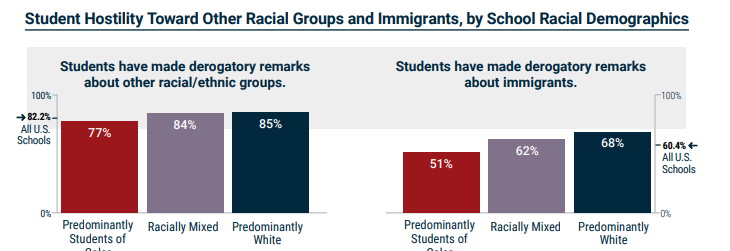
All the results make sense, but they are not always immediately intuitive. For instance, derogatory remarks about other racial/ethnic groups are more common than derogatory remarks about immigrants, and both are most common in predominantly white schools, but far from absent in the other schools. (See below.)

Principals are also most likely to report disciplining students for insensitive remarks in mostly-white schools, but they are much less likely to talk with their students about the importance of respecting immigrants in the mostly-white schools.

Many principals report proactive responses, such as meeting with student groups to ask for their help in promoting civility and respect or meeting with parents for similar purposes. But those responses vary greatly. Sixty-two percent of principals serving mostly youth of color met with parents for this reason, versus 37% of principals in mostly white schools.

It’s common today for parents to challenge the information or news sources that teachers assign or for students to reject assigned sources. The frequency of those events doesn’t differ dramatically depending on the schools’ demographics (although I imagine that the sources that are distrusted differ).

According to the report, “A little more than a quarter of principals report they have restricted topics or information sources in order to diminish the flow of unreliable or contentious information.”

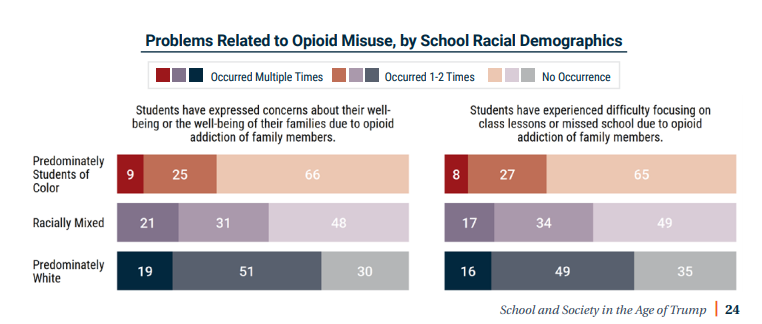
A different kind of stress comes from the opioid crisis. It is worst in predominantly white schools but definitely present in racially-mixed schools and those that serve mostly youth of color.

Rogers and colleague write that “Sixty-eight percent of the principals we surveyed report that federal immigration enforcement policies and the political rhetoric around the issue have harmed student well-being and learning, and undermined the work of their schools in general.”

Students across the board are fearful of gun violence, but more so to the degree that their students are people of color.

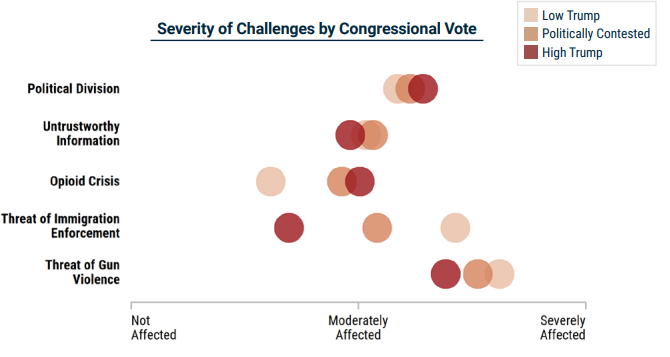
These challenges vary by demographics and region, but I’ll show a final graph about politics. The opioid crisis is most widely reported in Trump country. Political division is also more often reported there than elsewhere, but by small margins. In Trump country, far fewer principals report immigration enforcement as a challenge for their students. (That is either because of where most immigrants live or because of problems of under-reporting in Trump districts, as Rogers notes.) Untrustworthy information is seen as a challenge everywhere, to about the same degree, but I am sure that what counts as untrustworthy varies.

These are just some snapshots from a rich and compelling report.

how to think about other people’s interests: Rawls, Buddhism, and empathy

Last week, my colleague Erin Kelly and I taught excerpts from John Rawls’ Theory of Justice along with Emily McRae’s chapter, “Empathy, Compassion, and ‘Exchanging Self and Other’ in Indo-Tibetan Buddhism,” from the Routledge Handbook of Philosophy of Empathy. I then attended a conference on empathy. As a result, I’ve been thinking about Rawls’ famous thought-experiment, Buddhist exercises for moral improvement–and how empathy relates to both.

Rawls argues that to know what justice demands, you should collect all the relevant available information about how the society in general works, but you should then imagine that you don’t know your own position in the society and ask what rules and institutions you would favor–in your own interest–under this “veil of ignorance.”

To make that method seem intuitive, imagine that I am considering (in the light of last week’s scandalous news about college admissions) whether it is desirable for such institutions as Yale University to exist. I should try to understand how Yale functions, today and in the past, in the broader society. But I should try not to be influenced by the fact that I was admitted to Yale and graduated from there. I should ask whether the existence of Yale would be a good thing if I did not know whether I would ever get anywhere near it. Thus general knowledge plus self-interest plus ignorance about my own circumstance equals justice.

We could think of this thought-experiment as a way of modeling justice. Just as we test a model of a new airplane in a wind tunnel, so we test a theory of justice by using Rawls’ veil of ignorance, because that will yield the same results as justice itself would yield if we could know directly what justice says.

Now compare Rawls’ method to those developed in Indo-Tibetan Buddhism. McRae begins her chapter: “Imagine yourself as an old yak … your back weighed down with a load far too heavy, a rope pulling you by the nostrils, your flanks whipped, your ribs bruised by the stirrups.” She is quoting the nineteenth-century Tibetan master Parrul Rinpoche, who offers it as an exercise in empathy.

McRae defines bodhicitta as a “radically altruistic moral orientation that centrally involves cultivating oneself in order to be the kind of person who can reliably, effectively, and wisely benefit others… . The cultivation involved in becoming a person with bodhicitta–a bodhisattva — … includes developing virtues such as patience, generosity, and wisdom, and moral skills such as mindfulness, moral reasoning, responsiveness, and, arguably, empathy. … .Empathy practices [such as imagining that you are a yak] are traditionally presented in the context of cultivating bodhicitta, since empathy triggers both virtuous emotionality (through the Four Immeasurable Qualities practices) and the realization of no-self (through exchanging self and other practices), both of which are necessary for bodhicitta.”

Here are some differences:

  • Rawls tries to make moral reasoning as impersonal as possible, whereas the Indo-Tibetan Buddhist tradition strives for maximum concrete identification with other sentient beings.
  • In the Buddhist tradition, you cultivate empathy. Rawls provides a way of determining justice that does not require empathy–in part because empathy can be biased, manipulated, and otherwise untrustworthy.
  • Rawls treats every person as equal, whereas a stance of “radical altruism” implies that the thinker should count everyone else as more important than herself.
  • Rawls’ theory is limited to “persons” (probably human beings), whereas Buddhism extends to all sentient life.
  • Rawls offers a technique for deciding what justice is, whereas for the Buddhist theorists, the problem is not deciding what is right–they presume that we should be as altruistic as possible–but rather motivating people to act right. “Exchanging self and other is not simply a heuristic for determining the limiting condition on action (“how would you like it if someone did that to you?”) or a mental exercise in perspective taking. It is a transformative practice that uses empathic imaginative projection to chip away at self-clinging by softening the boundaries of self and other.”

And here are some similarities:

  • Both methods are conducted by the thinker alone. Neither is dialogic, involving an actual exchange of opinions. You imagine you’re a yak, but you don’t ask the yak if you got that right.
  • Like the Buddhist teachers, Rawls also softens “the boundaries of self and other,” but he does so by asking you what you’d want if you did not know who you were.

If you happen to find both arguments persuasive, you’re left with an odd proof:

1. Self-interest plus [a specific form of ] ignorance = justice (Rawls)

2. Compassion plus radical altruism = justice [Buddhism]

So

3. Self-interest plus ignorance = Compassion plus radical altruism

True?

See also: empathy, sympathy, compassion, justice; empathy: good or bad?; “Empathy” is a new word. Do we need it?; Owen Flanagan, The Bodhisattva’s Brain: Buddhism Naturalized; the grammar of the four Noble Truths; avoiding the labels of East and West; Philosophy as a Way of Life (on Pierre Hadot)

Civic Education: Is There Common Ground?

[The video just plays the introduction. Here is a link to all the separate talks.]

This is the video from a panel at the American Federation of Teachers’ Albert Shanker Institute on Wednesday. The panelists are: Leo Casey, Executive Director, Albert Shanker Institute, Jessica Marshall, co-author, “Let’s Go There: Making A Case for Race, Ethnicity and a Lived Civics Approach to Civic Education;” doctoral candidate, Northwestern University; former Director of Social Science and Civic Engagement for the Chicago Public Schools, Robert Pondiscio, Senior Fellow and Vice President for External Affairs, Thomas B. Fordham Institute, Joe Rogers, Director of Public Engagement and Government Affairs, Center for Educational Equity, Teachers College, Columbia University, and me. The moderator is Marla Ucelli-Kashyap, Assistant to the President for Educational Issues, American Federation of Teachers.

I thought the panel reflected some real diversity of perspectives, backgrounds, and opinions, yet we managed to stay focused on a common question: Is there common ground for civic education? My colleagues offered many important insights. My own view, for what it’s worth, is that common ground is available so long as we focus on the vessel into which the content of civics is poured: the need for courses, prepared teachers, funding for materials, etc. Once we begin to discuss how America should be presented to students, disagreements inevitably–and appropriately–arise. Content is the question that excites the most popular interest and concern, from a range of perspectives, and it must be addressed. But we don’t really know to what extent the content of robust civics programs would differ if they developed in more conservative and progressive communities.

conservatism as gratitude or humility?

(DCA) Yuval Levin offers this definition (h/t Robert Pondiscio):

To my mind, conservatism is gratitude. Conservatives tend to begin from gratitude for what is good and what works in our society and then strive to build on it, while liberals tend to begin from outrage at what is bad and broken and seek to uproot it.

You need both, because some of what is good about our world is irreplaceable and has to be guarded, while some of what is bad is unacceptable and has to be changed. 

This is a thoughtful effort to describe left and right evenhandedly, but I don’t think it is the best way to define or defend conservatism.

The problem is that people differ greatly in the degree to which they can reasonably be grateful to any particular polity. Consider, as one of several extreme examples, Native Americans. They can adopt any view of the USA that they want, but they have much less objective reason to be grateful to this republic than I have. They may well feel deep gratitude to their own communities. That gratitude is particularistic. Conservatism would then imply a particularistic ideal: a commitment to the specific communities that deserve each person’s gratitude. Some versions of conservatism have in fact been particularistic–but not Levin’s. He wants Americans (all Americans, I presume) to feel grateful to the nation-state:

But we can also never forget what moves us to gratitude, and so what we stand for and defend: the extraordinary cultural inheritance we have; the amazing country built for us by others and defended by our best and bravest; America’s unmatched potential for lifting the poor and the weak; the legacy of freedom—of ordered liberty—built up over centuries of hard work.

In the same essay, Levin suggests a more secure and persuasive core principle for conservatism—humility:

Conservatives often begin from gratitude because we start from modest expectations of human affairs—we know that people are imperfect, and fallen, and weak; that human knowledge and power are not all they’re cracked up to be; and we’re enormously impressed by the institutions that have managed to make something great of this imperfect raw material. So we want to build on them because we don’t imagine we could do better starting from scratch.

This reminder of “modest expectations” is what conservatism valuably contributes to public debates. Because people are “imperfect, and fallen, and weak”–or, we could say, cognitively and motivationally limited and biased–we should always be somewhat skeptical of ambitious reform proposals, of original designs for complex things (cities, welfare programs, markets), and of the likelihood that any person can dramatically improve things for any other person.

Humility, in this sense, is the common thread that unites libertarians (skeptical of central planning), religious conservatives (skeptical of human reason and motivation), and communitarians (skeptical of formal institutions). It also encourages all three types of conservatives to admire complex phenomena that have emerged and that seem to function well enough–“that have managed to make something great of this imperfect raw material.”

Levin argues that humility implies gratitude, but that connection is contingent. It depends on whether what has emerged so far is good enough for you and the people you care most about. Answers to that question will reasonably differ. Humility is the premise; gratitude is a consequent that depends on the circumstances. Humility is something that everyone has a reason to endorse, although everyone should also be open to the possibility of change.

See also: what defines conservatism?; a plea to conservatives; and from classical liberalism to a civic perspective