Monthly Archives: October 2007

the “civic core”

(Tampa International Airport) Ron Fournier of the Associated Press wrote a nice news/opinion piece based on the America’s Civic Health Index. It’s on the Yahoo news portal and elsewhere. Fournier begins:

WASHINGTON – It happens every election year: Pollsters slice and dice the electorate, identify an important new group and give those voters a fad-worthy monicker. Reagan Democrats. Angry Men. Soccer Moms.

Here’s a heads-up on what should be the dynamite demographic of 2008: “The Civic Core.”

That’s the name given to 36 million Americans who actively discuss society’s problems and work to solve them. These community-building citizens are both a key to the nation’s future and a valuable resource for political candidates.

And yet, with few exceptions, Democrats and Republicans alike are giving the Civic Core — and community service itself — short shrift.

Thirty-six million is a soft estimate, because the survey questions on which it is based are all matters of degree. You can be more or less involved, for example, in addressing problems in your neighborhood. Therefore, you may answer a yes/no question about such involvement differently depending on the context in which you are asked. However, I pushed for throwing out some kind of estimate, because I want candidates to realize that millions of Americans are heavily involved in civic work and care about their opportunities to participate. As Fournier says at the end of his article: “Microtarget that.”

Mobilize releases the Declaration of our Generation

Below in italics is the draft document, entitled Democracy 2.0 Declaration, that Mobilize.org has put together through an intensive collaboration. They will be posting it as a wiki so that it can be edited by other young people, although I don’t see how it could be improved. Apparently, they finished the drafting well after midnight (in the great tradition of the Port Huron Statement) and carried it down to Washington’s Tidal Pool to read it to Thomas Jefferson. Some say he shed a tear.

[You may have heard of TJ. He was on the development team of Democracy 1.0. They used a lot of open source components from projects in Greece and England (believe it or not), but they really took the concept to scale for the US market. Their product was kind of buggy. Some users were dissatisfied and there was a big issue around 1860 that almost killed the business. Still, thanks to user input, it turned into a robust platform. The 2.0 upgrade is eagerly anticipated.]

Democracy is an unfinished project. It’s time we upgrade.

We, the Millennial Generation, are uniquely positioned to call attention to today’s issues and shape the future based on the great legacy we have inherited. Our founding fathers intended for every generation to build, indeed to innovate, on the American experience. We realize that as young people we are expected to be the leaders of tomorrow, but we understand that as citizens we are called to be the leaders of today.

We are compelled by the critical state of our present democracy to establish a new vision.

In a world often damaged by conflict and intolerance, we must commit to develop common ground through equality and open mindedness.

In a world often damaged by social isolation and materialism, we must commit to community at the family, local, national and global levels.

In a world often damaged by instant gratification, we must commit to creating sustainable solutions.

In a world often damaged by apathy and disillusionment, we must commit to civic participation and inclusion of all voices.

The present state of our democracy impedes opportunity for real change. We must connect the specific issues failing our population with their underlying systemic causes.

Our government seems unable or unwilling to adequately address our broadest problems, including economic inequality, America’s role in the world, and the effect of money on the democratic process. But we must remember, our government is only as effective as the sum of its citizens. Low civic participation means the most disadvantaged people in society are neglected and we overlook many potential solutions to our problems.

Our generation is telling a different story. We are uniquely positioned to foster community engagement through social networks of all kinds. It is our responsibility to use information and technology to upgrade democracy, transform communication and advance political engagement and civic participation.

We are social networkers, we are multi-taskers, we are communicators and we are opinionated. The informality of our generation breaks down traditional barriers and opens doors for inclusiveness and equality. Most importantly, we are leaders in a society that yearns for leadership.

It’s our democracy, it’s time to act.
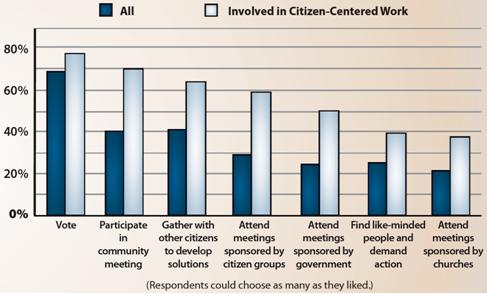
America’s civic core

Today, the National Conference on Citizenship released its annual Civic Index report, which we worked on heavily. The most innovative aspect of the report was a decision to focus on a new set of civic activities–not ones that we should hope everyone would undertake (such as voting and volunteering), but relatively demanding forms of engagement. We defined a group that does “citizen-centered work” (using the terminology of Cindy Gibson’s white paper for the Case Foundation). This means a combination of talking about issues and working directly to address problems. Look at how heavily engaged this group of millions is:

We also defined groups of “deliberators” (who participate in diverse discussions of issues) and “netizens” (who participate heavily online). They too are heavily engaged and well-informed.

I can describe how I got to this approach by way of an imaginary dialog:

Realist: Americans are resistant to conflict and controversy. They opt for consumerism and limit their political conversations to people just like themselves in order to avoid the tensions that arise when serious issues are on the table and participants have diverse values. (“Realist” may have been reading books that present impressive and depressing empirical evidence, written by Diana Mutz, Nina Eliasoph, and John Hibbing and Elizabeth Theiss-Morse).

Idealist: We know how to recruit diverse people for deliberative forums, train them to hold respectful, productive discussions, moderate these discussions, reach constructive conclusions, act voluntarily, and bring their experience back into discussions. (“Idealist” may have been reading the Deliberative Democracy Handbook, edited by John Gastil and me.)

Realist: What powerful, large, well-funded institutions have incentives to organize these forums? Not political professionals, corporations, parties, or the mass media. Deliberations will always be small-scale experiments, organized by boutique programs, and limited to highly civic communities.

I’ve struggled with Realist’s rejoinder for a while, and this is what I’m now prone to say:

Peter (the chastened idealist): Everyone has the right and the intrinsic ability to participate, but we’ll never have the resources or incentives to achieve a truly deliberative democracy on a mass scale. Yet our new survey shows that a significant minority of Americans actually do deliberate with other people and use the results to guide their civic behavior, such as their volunteering. Our strategy should not be to raise that proportion to 50% or 100%–although 25% might be achievable. Instead, we should strive to make the civic minority in America fairly representative of our nation’s diversity. We should give those people the tools, institutions, and resources they need. We should increase their political clout. We should build networks to connect them with one another. And we should make sure that all Americans have a shot at entering this civic minority even if they come from very disadvantaged backgrounds.

Open Congress

I like Open Congress. This group has now created a widget that you can place on your blog or other website to follow automatically the progress of a bill that you care about. I can’t really use the widget right now, because the legislation that interests me most is Rep. George Miller’s proposal for a renewal of the No Child Left Behind Act. Mr. Miller is the House leader on education, so what he puts in the bill that he actually introduces will be very influential. But right now there is much debate and advocacy going on, and I don’t think Mr. Miller has yet introduced a bill. He has, instead, floated various draft documents. Those drafts cannot be tracked by something like Open Congress.

This situation underlines a limit with any accountability mechanism that focuses on bills and votes. An enormous amount of what Congress does happens before a bill is introduced–or squashed. This is also where most special-interest pressure is exerted. I have no reason to think that special interests are influencing Mr. Miller on NCLB; if anything, he seems to be annoying all the major players. But the time when openness is most important and hardest to obtain is before a bill is introduced.