Monthly Archives: May 2006

a 10-point plan for civic renewal

Major trends have worked against civic participation in America, although a network of dedicated people has struggled to improve our civic life. Fortunately, new national political leaders will emerge between 2006 and 2008. We can hope that at least one of them makes “empowerment” a leading theme in his or her campaign. Or perhaps candidates will speak of “true democracy at home and abroad.” Or they could revive populism, along the lines Harry Boyte proposed here on Monday. In any case, the big message would go something like this:

American citizens have been pushed out of all our major institutions–the government, schools, health care, environmental protection, crime prevention, city planning, and the news media. That’s partly because lobbyists and other rich people have bought too much power. Sometimes it’s because courts and bureaucracies have made decisions that should be left to communities. Often it’s because experts claim too much authority. Although we should respect the expertise of lawyers, economists, regulators, and professional educators, these people don’t know right from wrong better than anyone else. Nor do they understand everyone’s needs and experiences. We must find ways to tap the energy, creativity, and values of many more Americans if we are going to address our communities’ problems.

To be credible, any such message must be backed up with reasonably specific policy proposals. Appropriate policies might include the following:

1. Putting communities back in control of education. Whole communities educate kids, not just the professionals who work in k-12 schools. Although the No Child Left Behind Act has some merits, it is making standardized tests all-important, thus empowering the testing industry and preventing communities from deciding what they value most. Often, people prize moral and civic education as well as, or above, reading and math scores. The Act needs to be revised so that a core of reading, math, and language-arts remains, yet communities can set other priorities and participate in educating their children.

2. Reforming Congress to check the power of professional lobbyists. Although basic ethics rules are important and must be enforced, the core problem is that lawmaking is not transparent. Therefore, well-placed insiders can obtain too much power. Dramatically simplifying the tax code on a revenue-neutral basis would reduce opportunities for special interests to seek special breaks. (The current code is about 10,000 pages long and generates about 4,000 pages of forms.) Congress should also create a bipartisan commission to simplify and regularize the Code of Federal Regulations, which is about 150,000 pages long.

3. A national service agenda. Instead of cutting or trimming the federal voluntary service programs (Americorps, Senior Corps, Peace Corps, and others), Congress should expand their funding while keeping them competitive and demanding evidence of results from grantees. The next president should also name a highly respected and famous director for USA Freedom Corps who will not only seek adequate funding for all the service programs, but also fight to give responsible, meaningful roles to volunteers. FEMA, the Defense Department, and all agencies should use talented and experienced volunteers to their maximum capacities.

4. Preparing a new generation of active and responsible citizens. People form attitudes and habits related to civil society when they are young and keep them for the rest of their lives. But civic education has been cut in most school systems, and there are too few opportunities for young people to learn through service and extracurricular activities. Congress should double the small Learn & Serve America program that provides competitive grants for service-learning. Congress should also preserve the Education for Democracy Act (slated for elimination in each of President Bush’s budgets) and add a new competitive program for school districts that agree to implement district-wide civics programs and collect outcome data. The next president should name an interagency task force on youth civic development that includes the Defense Department, Homeland Security, and the federal research agencies as well as the departments specifically concerned with education and service.

5. Rethinking government service. According to the Partnership for National Service, we would need about 800,000 new federal employees to replace those who are eligible to retire before 2010. Even if we assume that the federal workforce can be cut deeply, we still need about half a million recruits. Many younger people do not view the federal civil service as a desirable lifelong career. To meet the desires of college students as documented in a recent poll, we must create federal jobs that feel less bureaucratic and more interesting. (Raising pay is much less important.) This requires a new round of “reinventing government.” This time, the goal of reinvention should not be to improve customer service but to find ways to make stints in the civil service feel more creative, collaborative, and rewarding.

6. Charter schools: The charter-school movement is not a Trojan Horse designed to undermine public education. Charters are public schools–funded with tax dollars and authorized by the government. In fact, they stand to rejuvenate public education by giving more people opportunities to serve and innovate in the public sector. If there is any way to create the equivalent of charters in other areas of federal governance, that would be worth an experiment. An example might be community development corporations (CDC’s) that can manage development assistance.

7. A public voice in policymaking. Hurricane Katrina showed that the federal government is not ready to convene citizens to deliberate when we face crucial public decisions. Yet we know how to bring diverse citizens together in face-to-face and online settings and harvest their views. The federal government should create an infrastructure that is ready to organize public deliberations when needed. This infrastructure would consist of: standards for fair and open public deliberations, a federal office that could coordinate many simultaneous forums and collect all their findings, and a list of vetted contractors that would be eligible to convene public deliberations with federal grants.

The Wyden-Hatch “Health Care that Works for All Americans Act” would organize large-scale public deliberations on what to do about the 41 million Americans who lack health insurance. It would be a great pilot for future conversations on other issues.

8. Increase public deliberation through e-rulemaking. Only paid experts can possibly follow the thousands of new federal regulations that are proposed and enacted each year. That means that special interests that can afford expertise have a huge advantage, and many actual regulations benefit them alone. Proposed regulations should be issued in a searchable online format with threaded comments, opportunities to vote on the importance of proposals, and opportunities to add links and explanations. Then citizens will sort through this mass of material and add value.

9. New public media. Without government help, citizens are creating more diverse and interactive forms of media–mostly online–to counteract the consolidation of the commercial news and entertainment businesses. But there are big holes that require federal attention. First, radio has dramatically consolidated. The FCC must support alternatives, including low-power radio. Second, it is increasingly difficult for people to make fair use of copyrighted media in documentaries, hip-hop, and other cultural forms that rely on borrowing. Congress must protect fair use. Third, most kids aren’t learning sophisticated media skills. They must have opportunities to work with media in schools. Television is hardest to improve, but the next president should at least appoint leaders of public broadcasting who are willing to create an entirely new model to replace the current system of using membership drives and corporate advertising to support marginal programs.

10. Incorporate immigrants into civic life: The many millions of new immigrants need civic skills and opportunities. The INS citizenship exam should be revised so that it is not longer a set of trivia questions but instead tests the knowledge that new citizens will actually need to participate. Immigrants, legal or illegal, should have access to education and service opportunities.
the future of gay rights

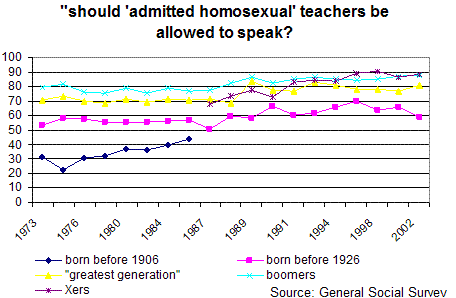
In the Detroit News, Deb Price has an article entitled, “Gay marriage’s future lies with DotNet youngsters.” She writes:

Even two years ago, 15- to 25-year-olds favored gay marriage by 56 percent to 39 percent, according to a national survey by the University of Maryland’s youth think tank, the Center for Information & Research on Civic Learning & Engagement (CIRCLE at civicyouth.org).

“Each generation has come of age being considerably more tolerant and become even more so,” says CIRCLE director Peter Levine, who tracked the attitudes of generational groups over time.

“This youngest generation is very tolerant, a very large group, and they have turned around the voting decline in the first election in which they could vote. If you put all that together, it spells a huge change in gay rights — and one not very far off,” he adds.

I was thinking of this kind of pattern, which is also seen in other survey questions about tolerance for gays:

[I’m also in a podcast by Joanna Welch, talking about the importance of being able to manipulate, recombine, and parody audio recordings of politics.]

“Civic Populism,” an essay by guest blogger Harry Boyte

Harry C. Boyte is a senior fellow at the Hubert H. Humphrey Institute of Public Affairs at the University of Minnesota and co-director of the Center for Democracy and Citizenship. Harry started his career working for Martin Luther King, Jr., as a field secretary for the Southern Christian Leadership Conference. His many excellent books include Building America: The Democratic Promise of Public Work and CommonWealth: A Return to Citizen Politics.

Harry recently suggested that I write on this blog about populism. I said that I don’t have the historical background to do it right, but I invited him to contribute something in his own voice. He has generously provided the following essay:

Civic Populism, by Harry C. Boyte

In common parlance “populism” means a folksy style or, negatively, demagogic leaders who profess to champion victimized people as cover for trouble-making. “Populism” or “populist” is thus the epithet used to criticize a group of Latin American leaders. Juan Forero reported in the New York Times (April 20, 2006) on “populist movements … promising to redistribute wealth [that] threaten to create a political free-for-all that could weaken already unstable countries.” Jorge Casta?eda followed with an op ed (“Good Neighbor Policy,” NYT, May 4, 2006), arguing that immigration reform is needed in order to halt “the wave of populism that has swept Latin American cities.”

Peter Levine, who invited me to reflect on populism in this civic space, has termed the rhetorical championing of innocent people against nefarious elites, “sentimental populism” (August 23, 2004). Yet in civic terms populism can be understood as something different, the heritage of democratic politics in the United States that is an alternative to liberalism and conservatism, with new currency today.

Populism took explicit shape in the movement of black and white farmers and their blue collar and professional allies in the 1880s and 1890s, culminating in the short-lived “People’s Party.” In broader terms it is a tradition in which civic agency and civic life built through cooperative work formed an alternative both to the paternalistic state and the untamed market. As the historian Eric Foner has argued, “Precapitalist culture … was the incubator of resistance to capitalist development in the United States. The world of the artisan and small farmer persisted … into the twentieth century and powerfully influenced American radical movements. … These movements inherited an older republican tradition hostile to large accumulations of property, but viewing small property as the foundation of economic and civic autonomy.” Foner proposed that in the U.S. it was “not the absence of non-liberal ideas but the persistence of a radical vision resting on small property [that] inhibited the rise of socialist ideologies.”

The emphasis on civic agency took new forms in the 20th century in an identifiable strand of democratic thought and action, what can be called civic populism or citizen-centered politics. This combines democratic respect and democratic power with democratic development–the idea that “the people shall govern” as they prepare themselves to govern. Civic populism has surfaced in broad movements such as early 20th century progressivism, New Deal reforms in the 1930s and 1940s, and the civil rights movement. Civic populism includes figures as diverse as Jane Addams, Liberty Hyde Bailey, Langston Hughes, Zora Neale Hurston, Saul Alinsky, Ella Baker, the Rev. Martin Luther King, and Linda Chavez-Thompson in our time. It also runs as important threads in the policy ideas and civic philosophies of political leaders such as the late Vice President Hubert Humphrey and the late Republican governor [of Minnesota] Elmer Andersen.

Civic populism once had wide foundations in what can be called mediating institutions connecting the civic life of communities to the larger public world. These included locally rooted political parties, religious congregations, businesses, unions, neighborhood schools, settlement houses, sometimes colleges and universities. Unions, for instance, were often deeply tied to communities. The black Minnesota union leader and civic populist Nellie Stone Johnson recalled that into the 1950s unions had store front offices, where people would socialize, discuss issues, and undertake community projects. Mediating institutions also included locally rooted public agencies, from local governments to cooperative extension and soil conversation districts.

These were places where people acted on concrete interests and received tangible benefits, while also learning public skills and habits of dealing with others who were different–negotiation, problem-solving, the messy improvisations of everyday politics. They also experienced the equal respect, freedom, and generative power that comes from common labours freely undertaken. Nick Bromell has described what emerges from such experiences as “the understanding that human equality is rooted in the activities of human beings, not in abstract rules that treat humans as mere blanks. Democracy [in these terms] doesn?t just allow us to govern ourselves; it produces selves that find the labor of self-government worth the effort?because those selves are worthy of respect.”

Civic populism integrates particular interests into a larger vision of the commonwealth or common good, a theme recently advocated for the Democrats by Michael Tomasky in “Party in Search of a Notion” (The American Prospect, April 18, 2006). But civic populism is more than a notion to win elections. It is a tradition stirring to new life in a fledgling movement for civic renewal, often brilliantly chronicled on this blog. Its deepest impulse is to transform the “Me First Culture” into a “We Culture.”

Civic populism addresses the dysfunctions of a Me First Culture because it challenges the technocratic politics–domination by detached experts–that generates such a culture. Technocracy, spreading through society like a silent disease, presents itself as an objective set of truths, practices, and procedures. But it turns people into abstract categories. It decontextualizes problems from civic life. It privatizes the world and creates a pervasive sense of scarcity. It profoundly erodes a culture of equal respect.

Civic populism counters the impersonal, hierarchical patterns of technocracy while transforming the Me First Culture of isolation, fear, consumerism and scarcity that is technocracy’s degraded progeny. Civic populism retrieves citizen politics as the way we negotiate the plural, relational, narrative qualities of the human condition in order to solve problems and live together without violence. It revitalizes civic cultures of mediating institutions that have narrowed in recent decades to providing services to needy clients and consumers. It generates a spirit of abundance by tapping the enormous civic energies and talents now stifled by technocracy. Finally, civic populism cultivates civic habits and outlook among professionals and amateurs alike–an understanding of ourselves as citizens working alongside our fellow citizens, neither above nor below.

I believe that civic populism can be enriched, deepened, and translated into public debate by integrating themes of citizenship, community, and public life through the idea of a politics that aims at the strengthening of civic life. Civic life is a concept with broad resonance and appeal to many different groups. It suggests the context for cooperative labors, and the sense of public abundance that public work generates. Government in these terms is best conceived not as “the solution” or “the problem” but rather as the resource of the people in addressing our common problems and creating democracy.

Politicians can play important roles in articulating civic populism, but the concept of the impact of public policies on civic life needs to come from many directions. Moreover, the concept of civic impact of policies–what practices and policies contribute to civic life and generate cultures of civic abundance, and what erode civic life–can be applied not only to assessment of government, but also to many other institutions.

To renew democracy as a way of life will mean integrating civic populist examples into a broad challenge to a scarcity based technocratic politics. It will entail an alternative politics based on abundance. And it will mean remembering the heart of the populist faith, that democracy is embodied not mainly in structures or institutions, but in the wisdom, confidence, skills and habits of the citizenry.

stateless college students

Doug McGray has a great cover story in the LA Times Sunday magazine about kids who complete college in the US despite being illegal immigrants. For example, Thi was born in Germany to Vietnamese refugees who took her to the US when she was very small. She is not eligible to work, live, or vote in any country. Her parents didn’t initially understand their own immigration status, but when Thi finally learned from a lawyer that she is stateless, the lawyer said, “Grow some balls. This happens to people.”

People like Thi (an excellent student and great “citizen” who worked at a local police station during high school) are ineligible for in-state tuition and financial aid. She and many others make their way through college, anyway. Thi is a senior at UCLA. Yesterday, I met an originally undocumented Kenyan who had paid her own way through a BA and an MA in the US.

There is legislation in Congress, the DREAM Act, that would grant high school graduates conditional resident status. If they graduated from college or completed military service, they would be eligible for Green Cards. The DREAM Act has been pending since 2001.

The secret thoughts of a Maryland School of Public Policy prof

No wonk has ever won a vote, yet we’re the ones who rule.
For us, the whole of Washington’s become a kind of school.
The politicos are our students; they show up from the sticks
With shiny smiles, fancy suits, and campaign-finance tricks.
But when we talk cost/benefit, chi-squared, or Freddie Mac,
Their brains feel slow, their spirits, low; their mouths look kinda slack.
“You profs,” they drawl, “it seems y’all know exactly what to do.
You write the bill, just as you will, and tell us when you’re through.”
In College Park, we’ve students, too; they’re the ones who pay us.
But they don’t exactly have the clout to make us into playahs.
That’s why we love the World Bank, C-SPAN, or a think tank,
Anywhere that cameras roll and the offices are swank.
Civic engagement? Sounds like a drag.
Public deliberation? Don’t make me gag.
A populist revolt? Not in our time.
The people only care about celebrities and crime.
Youth are dumb and selfish, but that’s really no surprise.
Their parents can’t detect the most patronizing lies.
Voting’s overrated: I’ve hardly ever done it.
As for the government, who’d really want to run it?
And while I’m getting all of this off my panting chest,
What about the folks who think that Maryland’s the best?
Please, a Terp is a turtle with his head up in his … shell.
Against a Blue Devil, he’s got a snowball’s chance in hell.
The Terps are meek, the ozone’s weak, our troops are up a creek.
Philosophy’s obsolescent and the future’s looking bleak.
Net intelligence is constant, but the population keeps on growing.
We’re out of cash, ideas, and friends, but the mess is still ongoing.
The end is near, I sadly fear, for planet, country, school.
But I get paid for opinions, so my future’s looking cool!